on-this-day · january 17

portrait of benjamin franklin, painted by david martin, 1767. source: wikimedia commons

The Original Polymath
On this day in 1706 — Benjamin Franklin was born. Scientist, printer, designer of a nation.
2 min read
Benjamin Franklin was born in Boston on January 17, 1706, the fifteenth of seventeen children. His father made soap and candles. Franklin had two years of formal schooling. By 12, he was apprenticed to his brother's print shop. Everything that came after grew from ink and metal letters.
Printing taught him that ideas could be reproduced, distributed, scaled. When he started publishing Poor Richard's Almanack in 1732, he wasn't just writing maxims -- he was designing an information product that fit the production capabilities of colonial America. It sold 10,000 copies a year for 25 years.
Franklin approached everything as a design problem. Lightning was killing people, so he invented the lightning rod. Homes were inefficient, so he designed the Franklin stove. Reading required two pairs of glasses, so he invented bifocals. The postal system was slow, so he became postmaster and redesigned the routes. He didn't theorize about electricity; he flew a kite in a thunderstorm.
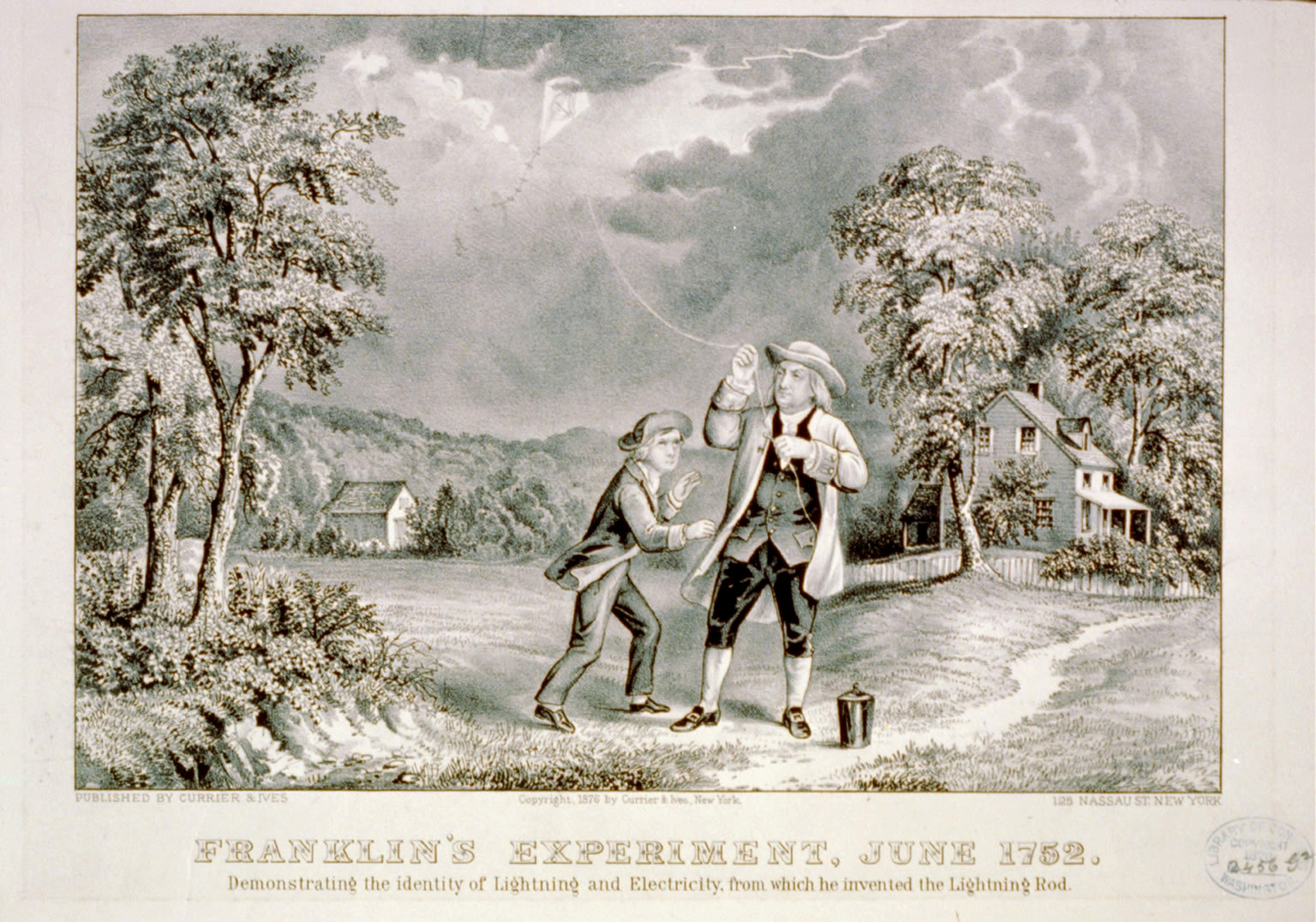
engraving depicting franklin's kite experiment with lightning, 1752, which proved lightning was electrical in nature. source: wikimedia commons

But his most consequential work was institutional. He founded the first public library, fire department, and public hospital in America. He helped design the postal system, the Constitution, and American federalism. These weren't physical objects but organizational architectures -- systems for sharing knowledge, distributing risk, balancing competing interests.
Franklin understood that institutions are designed artifacts with interfaces, feedback loops, and failure modes. He approached governance the way a printer approaches page layout: start with constraints, iterate on structure, test against real conditions.
He died in 1790 at 84. His self-written epitaph didn't mention electricity or diplomacy. It described him as a printer, comparing his body to a worn-out book awaiting a revised edition. Even in death, Franklin thought in terms of production, distribution, and continuous improvement.