on-this-day · november 18
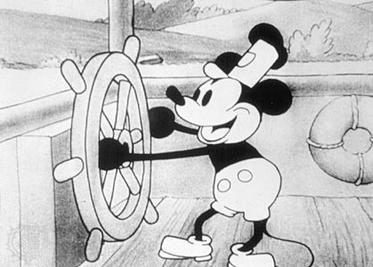
mickey mouse in steamboat willie, 1928. source: wikimedia commons

The Mouse That Built an Empire
On this day in 1928 — Mickey Mouse appeared in Steamboat Willie. Animation became a design industry.
2 min read
Steamboat Willie premiered at the Colony Theatre in New York on November 18, 1928. Seven minutes and 42 seconds long, black and white, and utterly unlike anything audiences had seen. The revelation was the sound. Mickey Mouse whistled, played a washboard, cranked a goat's tail like a hurdy-gurdy. Every movement was matched to every note. Synchronized sound turned cartoons from silent experiments into a medium with its own grammar.
Mickey was born from necessity. Disney had lost the rights to Oswald the Lucky Rabbit in a contract dispute. Facing financial ruin, he needed a character he owned outright. Mickey's design was simple to the point of abstraction: circles for ears, a pear-shaped body, gloves to hide the complexity of hands. He was built for efficient reproduction, a design object as much as a personality. Disney had tried two earlier Mickey shorts, but neither found distribution. Then he saw The Jazz Singer and understood that sound was the future.
Disney reworked Steamboat Willie with a full soundtrack, recording music with a small orchestra while projecting the film so the conductor could match tempo. The process was expensive, and Disney went into debt. But the premiere reaction was instant. Audiences laughed at sounds they had previously only imagined. Mickey became a phenomenon. Within years he appeared in films, comics, merchandise, and toys. The real innovation wasn't the character but the system Disney built to produce him at industrial scale.
Steamboat Willie entered the public domain in 2024. The early Mickey, with his sharp grin and chaotic energy, is now free to use. The modernized, polished version remains trademarked. Disney spent a century refining the character and protecting him legally. The film was the seed. The system was the tree. And the mouse, somehow, is still whistling.

walt disney, the man who turned a seven-minute cartoon into an empire. source: wikimedia commons
