on-this-day · november 23
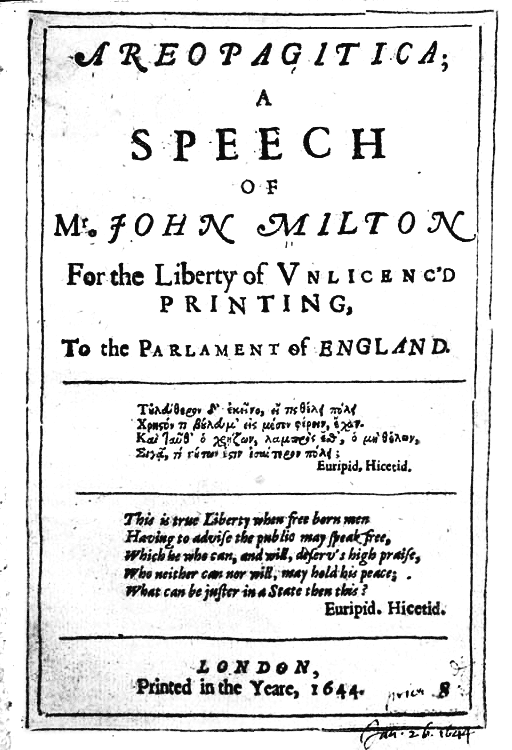
areopagitica title page, 1644. source: wikimedia commons

The Case for Unlicensed Truth
On this day in 1644 — John Milton published Areopagitica, arguing for freedom of the press. Information wants to be free.
2 min read
On November 23, 1644, John Milton published Areopagitica, a pamphlet arguing against the licensing of the press. Parliament had passed the Licensing Order of 1643, requiring government approval before any book or pamphlet could be printed. Milton, who had suffered censorship of his own writings on divorce, responded with one of the most powerful defenses of free expression ever written. He published it unlicensed, putting his own name on the cover and no printer's name at all.
Areopagitica argued that truth and falsehood must be allowed to compete openly. "Who ever knew Truth put to the worse in a free and open encounter?" Milton asked. He didn't argue that all speech was good. He argued that suppressing speech was worse than allowing bad speech, because censorship required censors, and censors were fallible. The system designed to protect truth would inevitably be captured by those who wanted to protect power.
Milton was no modern liberal. He didn't extend his argument to Catholics, whom he considered agents of a foreign power, or to atheists. His defense of free expression had limits that would disqualify it from any contemporary free speech debate. But the core logic was portable: licensing gives governments the power to define truth, and governments always define truth as whatever serves their interests. That argument has outlived every exception Milton attached to it.
The Licensing Act eventually expired in 1695, fifty-one years after Milton's pamphlet. The American First Amendment, the Universal Declaration of Human Rights, and every press freedom law in the world descend from the principle Milton articulated: let ideas compete, and trust the audience to sort them out. He was wrong about who deserved the right. He was right about the right itself. Most foundational arguments work that way.

john milton, author of areopagitica and paradise lost. source: wikimedia commons
