on-this-day · december 20

carl sagan, astronomer and science communicator. source: wikimedia commons

The Pale Blue Dot
On this day in 1996 — Carl Sagan died. He made the cosmos feel personal and pale blue dots feel like home.
2 min read
Carl Sagan died on December 20, 1996, at age 62, from pneumonia related to myelodysplastic syndrome. He had been fighting the blood disorder for two years. The man who spent his career making the universe feel close and personal was undone by something microscopic.
Sagan was a planetary scientist at Cornell, but his real talent was translation. He turned astrophysics into narrative. His 1980 television series Cosmos was watched by over 500 million people, making it the most widely viewed PBS series in history at that time. He spoke in sentences that made the scale of the universe feel intimate. "We are a way for the cosmos to know itself" is not a scientific statement. It's a philosophical one. But Sagan understood that science without meaning is just data.
He led the campaign to include a golden record on the Voyager spacecraft -- a message to any intelligence that might find it, containing music, greetings in 55 languages, and images of Earth. In 1990, he convinced NASA to turn Voyager 1's camera back toward Earth from 3.7 billion miles away. The result was the Pale Blue Dot photograph, and Sagan's meditation on it remains one of the most powerful pieces of science writing ever produced.
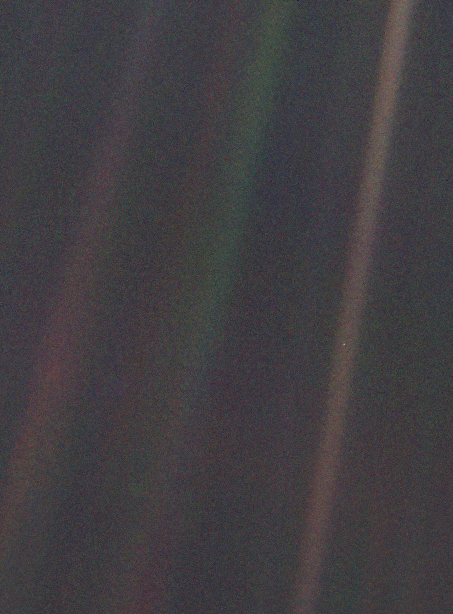
earth, photographed by voyager 1 from 3.7 billion miles away. source: wikimedia commons

Sagan also fought pseudoscience relentlessly. He debunked UFO claims, astrology, and superstition, not with contempt but with patience. His book The Demon-Haunted World argued that scientific literacy is essential for democracy. He championed the moon landing and SETI while insisting on rigorous evidence.
Sagan's gift was wonder. He made people care about things they couldn't touch, see, or visit. The cosmos didn't get smaller when he died. But it got quieter.