on-this-day · december 22
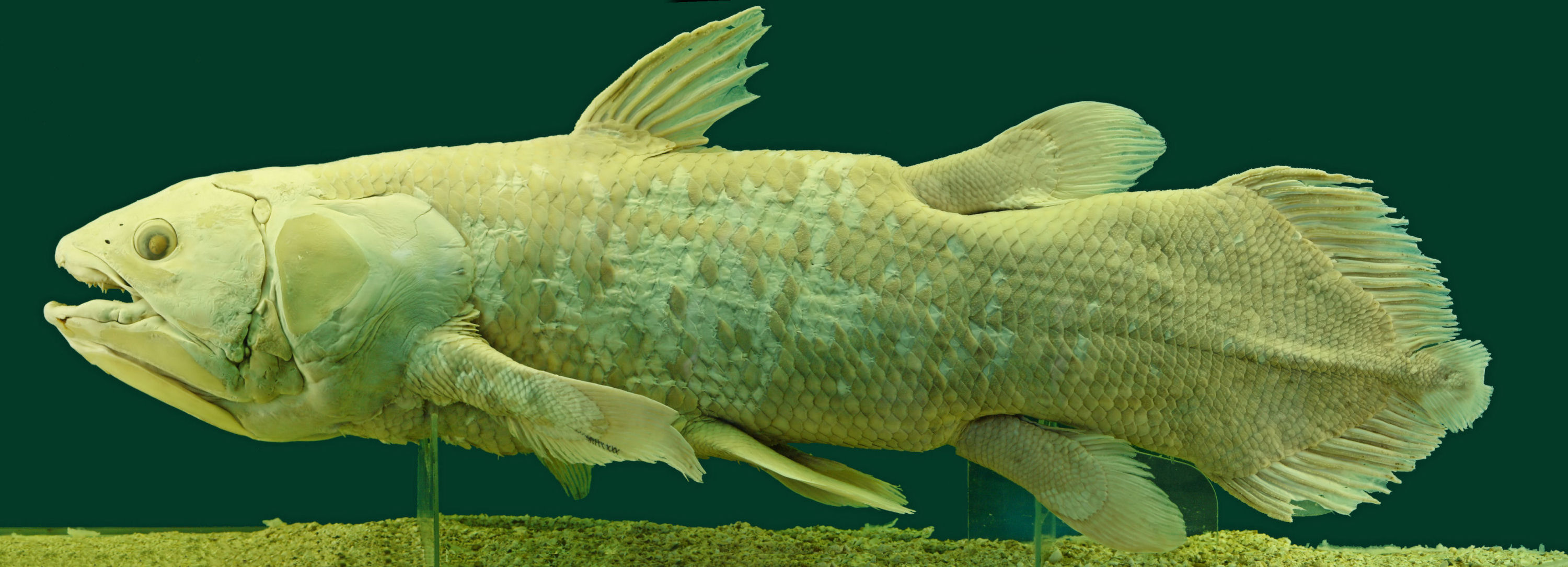
coelacanth, the living fossil. source: wikimedia commons

The Fish That Refused to Die
On this day in 1938 — The coelacanth was rediscovered. A fish thought extinct for 65 million years, alive off South Africa.
2 min read
On December 22, 1938, a fishing trawler off the coast of South Africa pulled up a strange fish. Nearly five feet long, blue-gray with white spots, covered in thick armored scales. Captain Hendrik Goosen brought it to Marjorie Courtenay-Latimer, curator of the East London Museum. She knew immediately it was extraordinary.
The fish was a coelacanth, a creature paleontologists believed had gone extinct 65 million years ago with the dinosaurs. Fossils dated back over 400 million years. No one expected to find one alive. The fish decomposed quickly in the summer heat, but Courtenay-Latimer's sketches and preserved scales reached ichthyologist J.L.B. Smith, who confirmed the identification. He named it Latimeria chalumnae.
The discovery shocked the scientific world. The coelacanth had fleshy, limb-like lobed fins -- structures thought to represent an evolutionary link between fish and land animals. Finding one alive was like discovering a living dinosaur. The fossil record was incomplete. The ocean still held secrets.

coelacanth model on display. source: wikimedia commons

Smith spent 14 years searching for a second specimen. In 1952, one was caught near the Comoros Islands. He reportedly wept when he saw it. In 1997, a second species was discovered in Indonesia. Coelacanths had survived undetected in deep waters for hundreds of millions of years.
The coelacanth is a reminder that absence of evidence is not evidence of absence. Just as Pluto's discovery expanded our map of the solar system, the coelacanth expanded our understanding of what survives. Extinction is often assumed, rarely confirmed. The ocean is deep, and deep things endure.