on-this-day · december 7
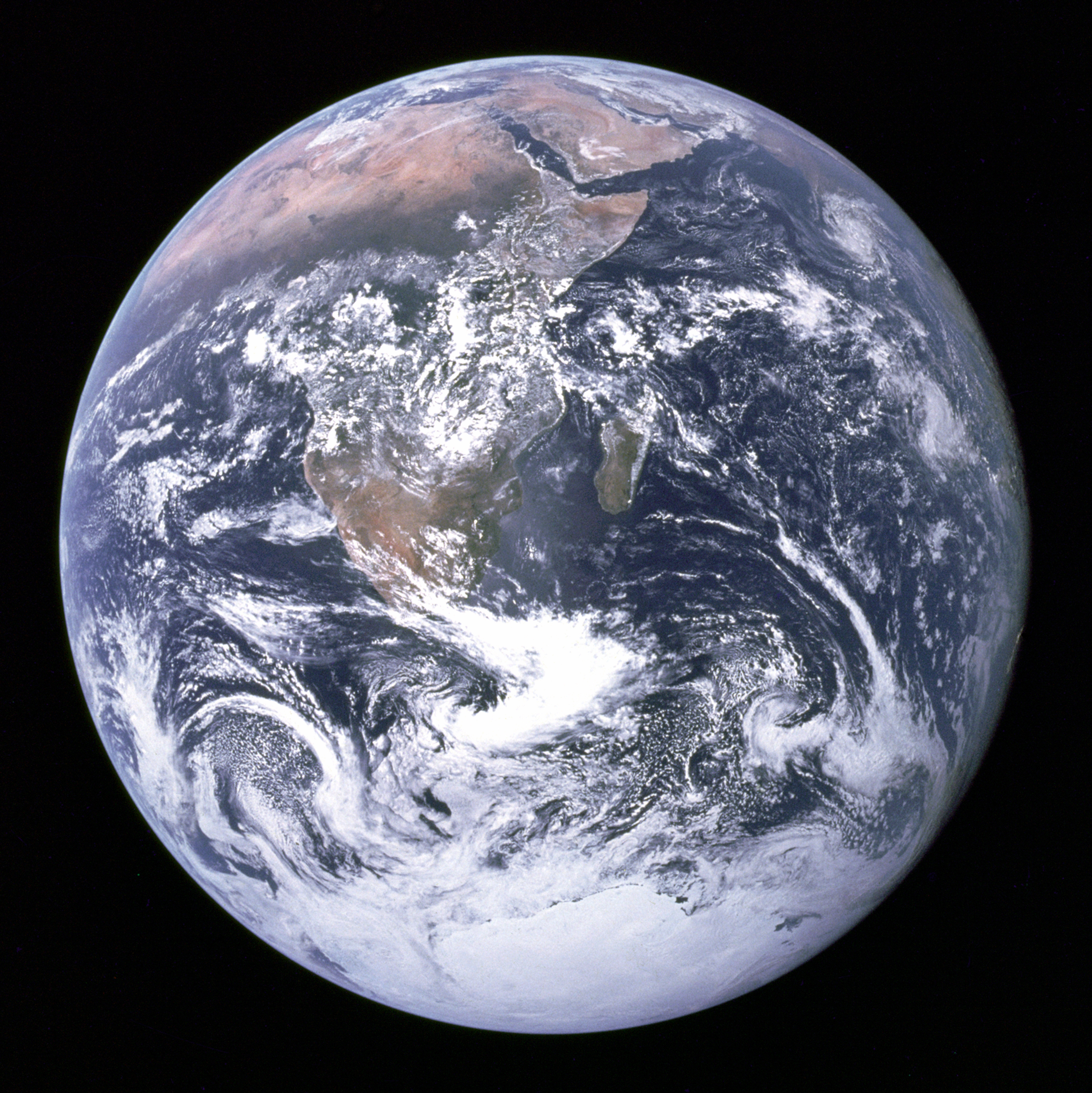
the blue marble, december 7, 1972. source: wikimedia commons

The Blue Marble
On this day in 1972 — Apollo 17 took the Blue Marble photograph. The most reproduced image in history.
2 min read
On December 7, 1972, the crew of Apollo 17 was five hours into their journey to the Moon when one of them looked back. About 29,000 kilometers from Earth, they saw the planet fully illuminated by the Sun. Africa. Madagascar. Antarctica. Swirling clouds over blue oceans. They grabbed a Hasselblad camera with an 80mm lens and captured a single frame. Cataloged as AS17-148-22727, it became known as "The Blue Marble" -- the most widely distributed photograph in human history.
No one knows who pressed the shutter. The crew -- Eugene Cernan, Ronald Evans, and Harrison Schmitt -- are all credited by NASA. It was the first photograph to show Earth fully lit from human eyes. Earlier missions captured partial views or crescents. This was the whole planet, sharp and impossibly beautiful.
The photograph became an icon of the environmental movement. Here was undeniable evidence that Earth is finite, fragile, isolated. No borders from space. No nations. Just water, land, clouds, and life on a small rock in an indifferent void. It also highlighted Apollo's paradox: all that engineering to go somewhere else, and the most valuable thing brought back was a picture of home.

apollo 17 prime crew: cernan, evans, and schmitt. source: wikimedia commons

Apollo 17 was the last crewed mission to the Moon. No human has traveled beyond low Earth orbit since December 1972. That photograph, taken casually during a routine leg, remains one of the mission's most enduring contributions. The astronauts went to the Moon. What they showed us was Earth.