on-this-day · february 13
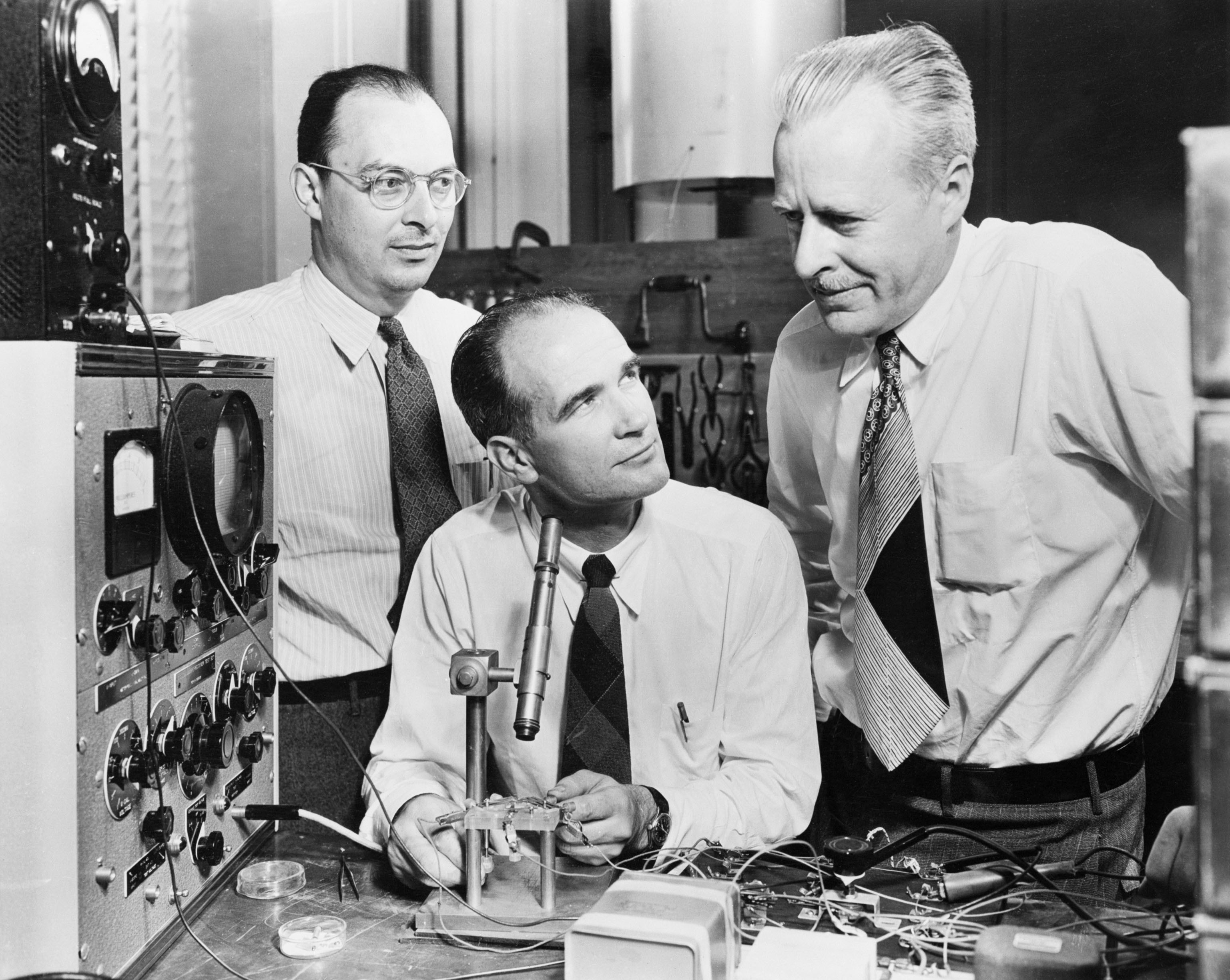
john bardeen (left), william shockley (center), and walter brattain (right) at bell labs in 1948, the three co-inventors of the transistor who shared the 1956 nobel prize in physics. source: wikimedia commons

The Tiny Switch
On this day in 1910 — William Shockley was born. He co-invented the transistor, the tiny switch that made every computer, phone, and machine possible.
2 min read
William Bradford Shockley was born on February 13, 1910, in London to American parents. Raised in Palo Alto, he studied physics at Caltech and MIT, then joined Bell Labs in 1936. There, he led a research group that included John Bardeen and Walter Brattain. In December 1947, Bardeen and Brattain built the first working transistor, a point-contact device that could amplify electrical signals. Shockley, their supervisor, was furious he hadn't been more directly involved.
Within weeks, Shockley developed a superior design: the junction transistor, a "sandwich" structure of semiconductor layers that was more reliable and easier to manufacture. It became the standard. The three men shared the 1956 Nobel Prize in Physics. The transistor replaced vacuum tubes in radios, computers, and telecommunications equipment, making electronics smaller, cheaper, and more efficient. It was the foundational technology of the digital age.
In 1956, Shockley left Bell Labs to start Shockley Semiconductor Laboratory in Mountain View, California. He recruited brilliant young engineers, then alienated them with paranoid, autocratic management. Eight of his best employees, later known as the "Traitorous Eight," left in 1957 to found Fairchild Semiconductor. Two of them, Robert Noyce and Gordon Moore, later founded Intel. Shockley's company failed. His management style had inadvertently seeded Silicon Valley.

william shockley at stanford university, where he became a professor after his semiconductor company's collapse, and where he later became notorious for his advocacy of eugenics. source: wikimedia commons

His later years were consumed by eugenics advocacy. He promoted theories of racial intellectual superiority, proposed a voluntary sterilization program, and donated to a sperm bank for Nobel laureates. His views were publicly condemned by colleagues and institutions. He died estranged from his children in 1989.
Shockley's legacy is a contradiction: the transistor enabled the most democratizing technology in human history, while its co-inventor spent his later years arguing that humanity should be selectively bred. The invention outlived the inventor's worst ideas. That's usually how it works.