on-this-day · march 1

henri becquerel, circa 1905. source: wikimedia commons

The Accident That Glowed in the Dark
On this day in 1896 — Henri Becquerel discovered radioactivity by accident. A photographic plate, a uranium salt, and a cloudy day.
2 min read
Henri Becquerel was investigating the wrong thing when he changed physics forever. On March 1, 1896, he announced to the French Academy of Sciences that uranium salts emitted invisible rays capable of exposing photographic plates, even in complete darkness. He had been studying phosphorescence. What he found instead was something that glowed on its own, from an energy source no one had imagined.
The discovery came from a failed experiment. Becquerel had wrapped photographic plates in black paper and placed uranium salts on top, intending to expose them to sunlight. His hypothesis was that sunlight would charge the uranium into emitting X-rays. But Paris was overcast. The plates sat in a drawer for days. On March 1, he developed them anyway. They were heavily exposed. The uranium had been radiating the entire time, in the dark, with no external energy.
Becquerel had stumbled on spontaneous radiation. Unlike phosphorescence, this was energy emerging from matter itself. Marie Curie gave it the name that stuck: radioactivity. Within two years, the Curies isolated polonium and radium. Becquerel's discovery became the foundation of nuclear physics, radiology, carbon dating, and the controlled chain reactions Enrico Fermi would achieve in 1942.
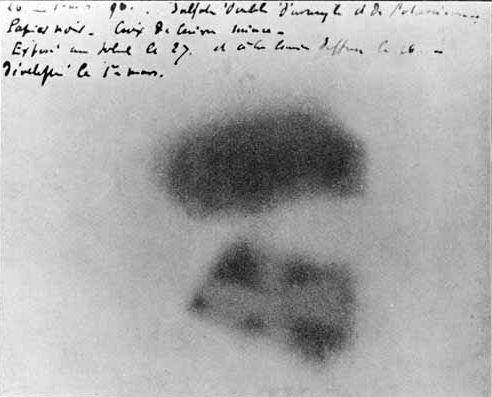
becquerel's photographic plate exposed by uranium salts through black paper, demonstrating spontaneous radiation. source: wikimedia commons

Becquerel shared the 1903 Nobel Prize in Physics with the Curies. He carried radium in his pocket and developed a radiation burn he did not connect to the sample for weeks. He died in 1908, likely from exposure. What he discovered was that matter has a half-life. Atoms are tiny clocks, counting down in the dark. The cloudy week that forced him to develop those plates early was an accident. But accidents are just experiments where the variables get rearranged.