on-this-day · march 29

asteroid vesta in natural color, photographed by nasa's dawn spacecraft in 2011. source: wikimedia commons

The Debris Field
On this day in 1807 — The first asteroid, Vesta, was discovered. The solar system turned out to be messier than expected.
2 min read
On March 29, 1807, German astronomer Heinrich Wilhelm Matthias Olbers discovered Vesta, the fourth asteroid identified. From his private observatory in Bremen, he noticed a faint point moving against background stars in the belt between Mars and Jupiter. Vesta was the brightest asteroid found so far, visible to the naked eye under dark skies.
Astronomers had been searching for a missing planet. A mathematical pattern predicted one between Mars and Jupiter. Ceres appeared in 1801 and seemed to fit. Then Pallas, Juno, and Vesta arrived in similar orbits. Too small for planets. Herschel proposed calling them asteroids. By the 21st century, the count exceeded a million. The belt is not a failed planet but remnants of a formation process disrupted by Jupiter's gravity.
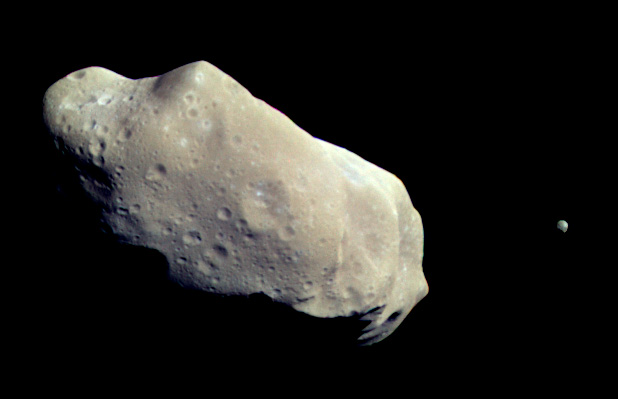
asteroid 243 ida, a typical main belt asteroid, photographed by the galileo spacecraft in 1993. source: wikimedia commons

Vesta is unusual. About 326 miles across, it has a differentiated interior: metallic core, rocky mantle, basaltic crust. A protoplanet that never grew. In 2011, NASA's Dawn spacecraft orbited Vesta for over a year, revealing mountains, valleys, and ancient volcanic activity. More similar to rocky planets than typical asteroids.
Asteroids complicate the tidy solar system model. They swarm, collide, fragment. Some are solid rock, some rubble piles, some contain water or metals. Construction debris from 4.6 billion years ago. They also pose threats. The dinosaur-killing asteroid was six miles wide. In 2022, NASA's DART mission altered an asteroid's orbit by impact. What Vesta represents is incompleteness. The solar system is not finished design but dynamic system. Every system, no matter how orderly, contains traces of the disorder that created it.