on-this-day · march 7

alexander graham bell, portrait photograph, the year he was granted his telephone patent. source: wikimedia commons

The Day Hello Became Universal
On this day in 1876 — Alexander Graham Bell was granted a patent for the telephone. Hello became universal.
2 min read
On March 7, 1876, Alexander Graham Bell received U.S. Patent No. 174,465 for an "improvement in telegraphy." The title was modest. What Bell had actually invented was a way to transmit human voice electrically over a wire. Three days later, on March 10, he would make the first successful telephone call. The patent, filed just hours before a competitor submitted a similar design, became one of the most valuable documents in history.
Bell's key contribution was the variable resistance transmitter, which modulated electrical current in sync with sound waves. Speak into the mouthpiece, a diaphragm vibrates, changing resistance in a circuit. The changing current travels down a wire and drives another diaphragm at the other end. Simple in principle. Devilishly hard to execute. Bell filed his patent on February 14, 1876, just hours before Elisha Gray submitted a caveat for a similar device. Patent law favored the inventor who could demonstrate reduction to practice. Bell got there first, and first mattered.
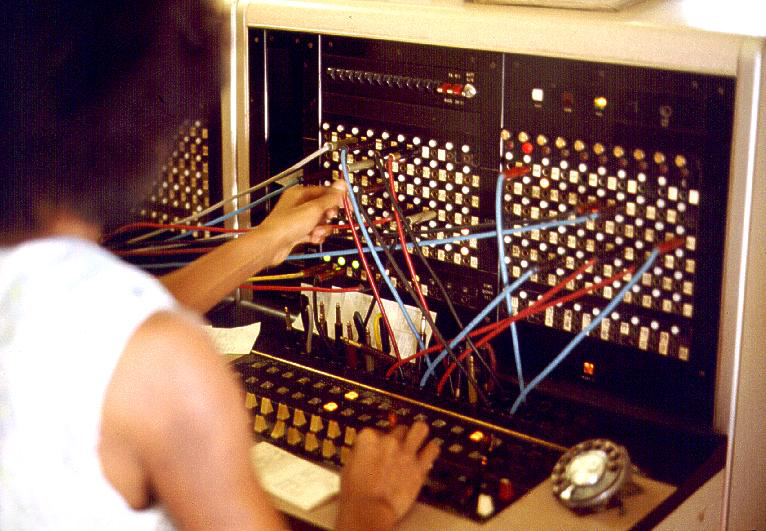
telephone switchboard operators manually routing calls — the human infrastructure of the telephone network before automation. source: wikimedia commons

The telephone changed social behavior in ways telegraph never could. Telegraph required operators and code. The telephone was immediate and personal. You could hear tone, inflection, hesitation. Thomas Edison suggested "hello" as the standard greeting in 1877. Bell preferred "ahoy," but Edison's version stuck. Before the telephone, "hello" was rarely used. The telephone turned it into a ritual, a signal that communication was about to begin.
The telephone also created new labor. Switchboard operators, mostly young women, manually connected calls. At its peak, this was one of the largest employment categories for women in the United States. By the time Bell's patent expired in 1894, over 250,000 phones were in use. Independent companies flooded the market. The telephone stopped being a luxury and became a utility. The network grew because people wanted to be part of it.