on-this-day · april 9
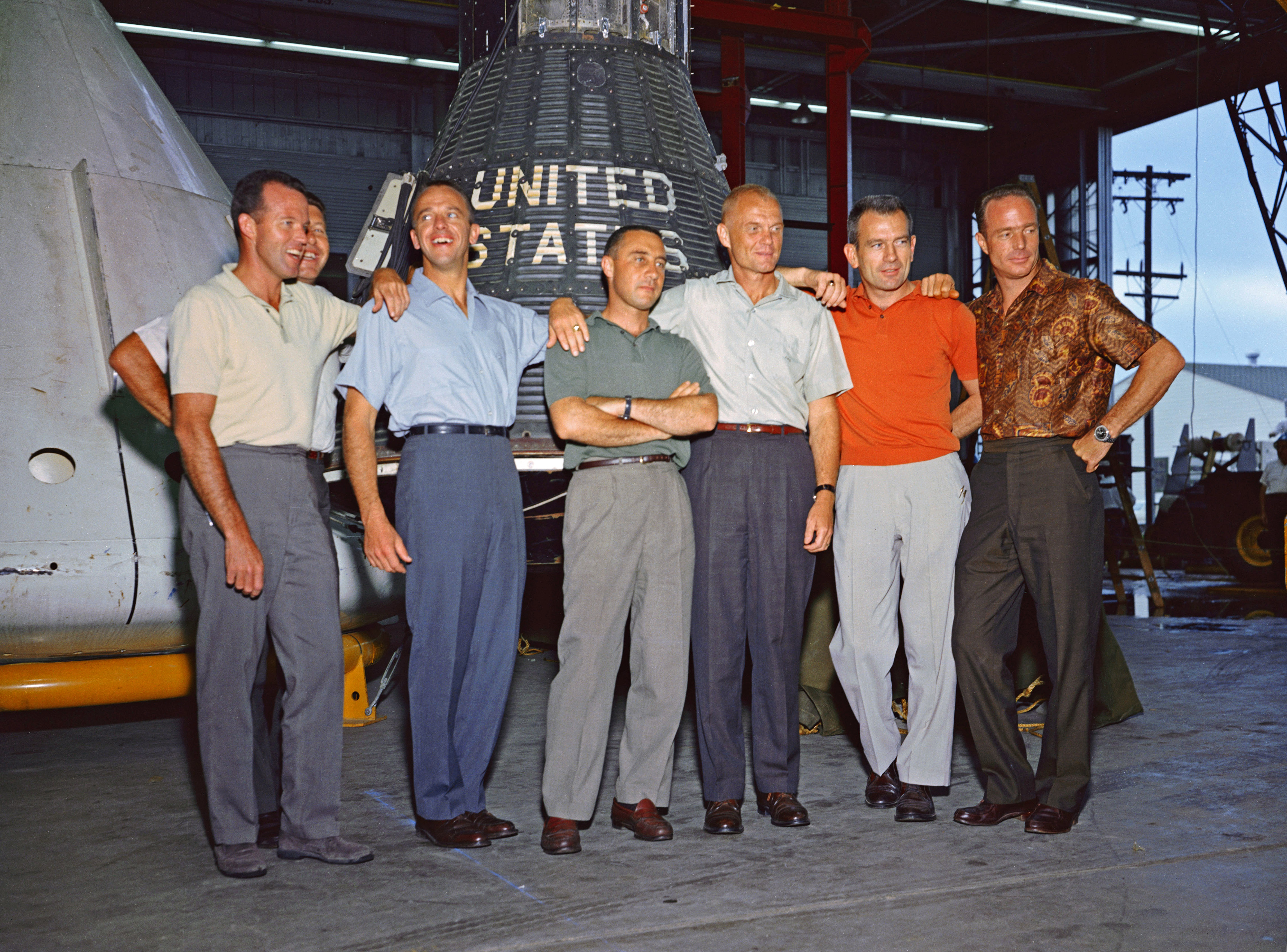
the mercury seven, nasa's first astronaut class announced on april 9, 1959. front row: walter schirra, donald slayton, john glenn, scott carpenter. back row: alan shepard, virgil grissom, gordon cooper. source: wikimedia commons

Seven Humans Designed to Leave Earth
On this day in 1959 — NASA announced the Mercury Seven, America's first astronauts. Seven humans designed to leave Earth.
2 min read
On April 9, 1959, NASA introduced seven military test pilots to the world. Scott Carpenter, Gordon Cooper, John Glenn, Gus Grissom, Wally Schirra, Alan Shepard, and Deke Slayton. They were the Mercury Seven, the first astronauts, standing in civilian suits trying to look ordinary while representing something unprecedented.
The selection was brutal. NASA started with 508 military test pilots. Requirements: under 40, under 5 foot 11 to fit the tiny capsule, peak physical condition, psychologically unbreakable. After invasive medical exams and tests designed to break them, seven remained.
The Mercury capsule was barely large enough for one person. The astronaut lay on a contoured couch, sealed inside a metal can launched on a rocket that could explode. Engineers called them passengers. The pilots hated that. They demanded manual controls, a window, an escape hatch they could open themselves. NASA compromised. The capsule became collaborative rather than fully automated. The astronauts weren't payload. They were pilots.

the mercury seven astronauts — all military test pilots — posing with a u.s. air force aircraft. they pushed nasa to give them manual controls and pilot authority over the automated mercury capsules. source: wikimedia commons

Two years later, Alan Shepard became the first American in space — a 15-minute suborbital flight aboard Freedom 7. John Glenn followed in 1962, orbiting Earth three times. Not all seven flew on schedule. Deke Slayton was grounded by a heart irregularity and didn't reach space until the Apollo-Soyuz mission in 1975. Gus Grissom died in the Apollo 1 fire in 1967.
The Mercury Seven were the first humans designed as components of a larger system. But they weren't passive — they shaped the system as much as it shaped them. They insisted on the title of pilot, not passenger. They proved that human spaceflight isn't just about surviving the journey. It's about designing the journey to include the human.