on-this-day · may 15

james puckle's original 1718 advertisement for the defence gun, showing the revolving cylinder design. source: wikimedia commons

Mechanical Repetition
On this day in 1718 — James Puckle patented the machine gun. Mechanical repetition applied to destruction.
2 min read
On May 15, 1718, James Puckle, a London lawyer and inventor, received a patent for what he called the Defence Gun. It was a tripod-mounted, single-barreled weapon with a revolving cylinder that could fire roughly nine rounds per minute -- three times faster than a trained soldier with a musket. In an era when military firearms required reloading after every shot, this was a radical concept: mechanical repetition applied to destruction.
The design was clever. The cylinder held multiple pre-loaded chambers that rotated into position behind the barrel. The operator cranked the mechanism, aligned the next chamber, and fired. Puckle even proposed two versions: one with round bullets for Christian enemies, and one with square bullets for Ottoman Turks, supposedly to demonstrate "the benefits of Christian civilization." Whether this was sincere or satirical remains debated.
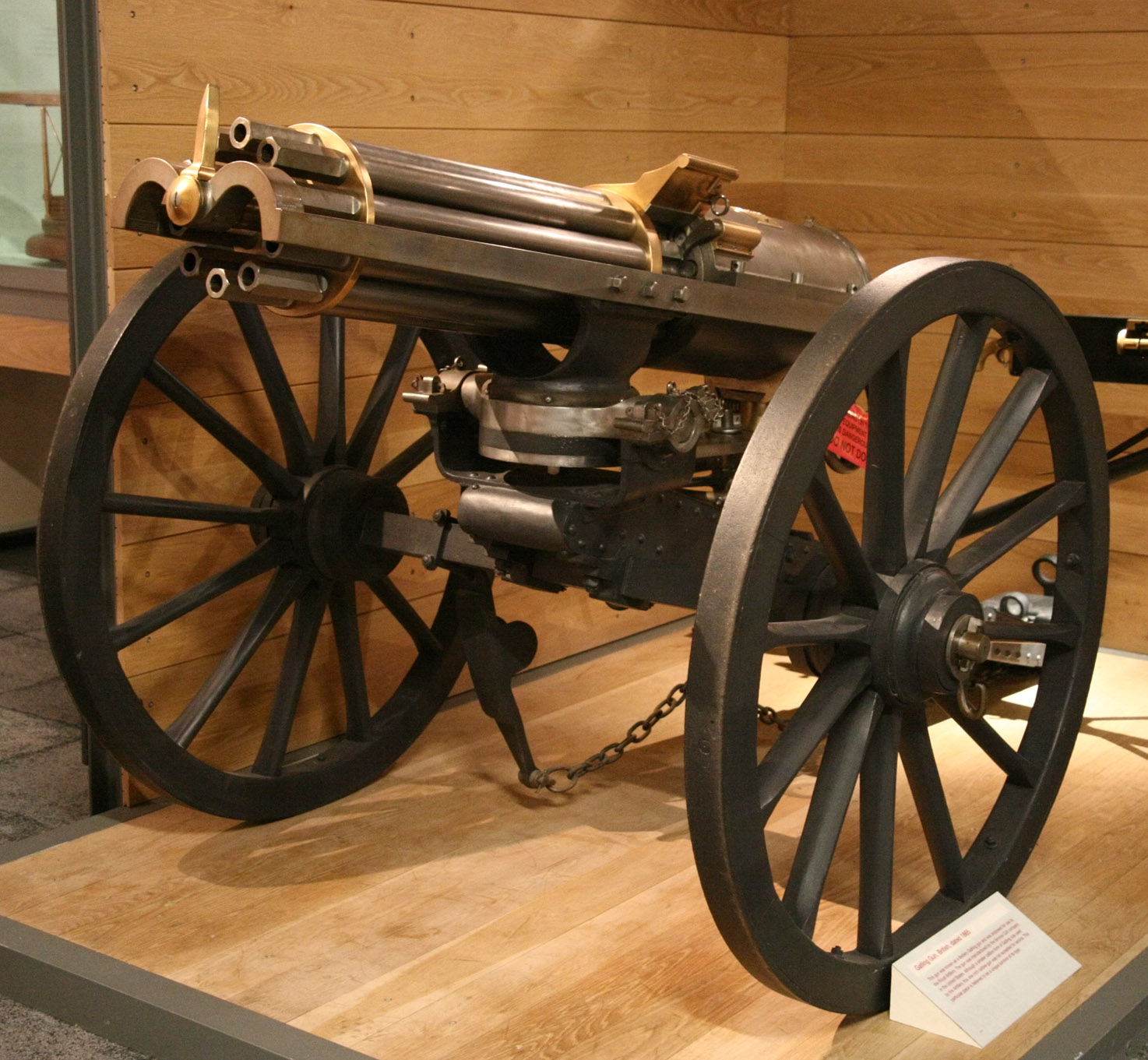
a gatling gun, 1865 -- the weapon that realized puckle's concept of mechanized rapid fire a century and a half later. source: wikimedia commons

The gun drew few investors and never achieved mass production. It was unreliable -- flintlock mechanisms jammed frequently -- and the military establishment was uninterested. Only a handful were ever built. The concept was sound, but the materials science and manufacturing precision required to make it work reliably did not exist yet. It would take another 150 years before the Gatling gun, and later the Maxim gun, made rapid-fire weaponry a battlefield reality.
What Puckle demonstrated was that destruction could be industrialized. The Defence Gun was a prototype for the mechanization of killing that would transform warfare in the 19th and 20th centuries. The patent was a design document for a future that was not yet ready to be built. When it was, the consequences were devastating.