on-this-day · june 1

robert watson-watt, pioneer of british radar. source: wikimedia commons

Seeing Without Light
On this day in 1935 — radar was first demonstrated in Britain. Invisible waves revealing invisible objects.
2 min read
On February 26, 1935, in a field in Northamptonshire, Robert Watson-Watt watched a flickering trace on a cathode-ray tube and saw something no one had seen before. A Handley Page Heyford bomber passed overhead at five thousand feet, and on the screen, the invisible revealed itself through radio waves bouncing back like echoes. This was radar, though the name would come later. What Watson-Watt had built was a new kind of vision.
The principle was simple. Send out radio waves. If they hit something solid, they bounce back. Measure the time, you know the distance. Watson-Watt was not the first to consider radio for detection -- Christian Hulsmeyer demonstrated a ship-detection system in 1904. But Watson-Watt proved it could work at scale, with enough precision to matter. By 1935, war with Germany felt like a schedule. Within four years, Britain had built Chain Home, a network of radar stations scanning the coast.
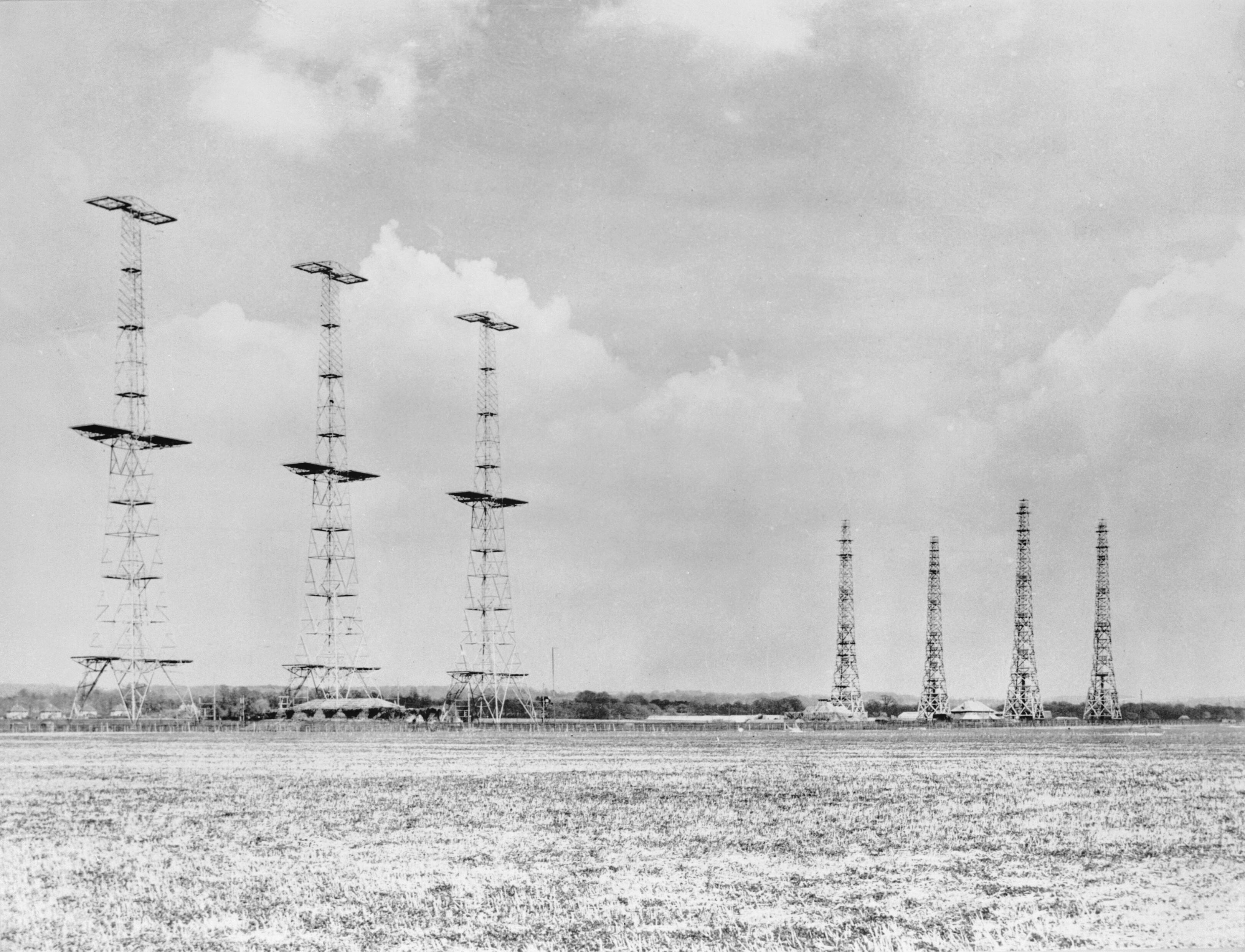
chain home radar installation at poling, sussex, 1945. source: wikimedia commons

When the Luftwaffe came in 1940, radar gave the RAF something irreplaceable: time. Pilots scrambled before bombers arrived. Fighters intercepted. The Battle of Britain was won by courage and skill, but also by information -- the ability to see the invisible.
After the war, radar went everywhere. Air traffic control. Weather tracking. Venus mapping through opaque clouds. The microwave oven is a descendant, invented when Percy Spencer noticed a magnetron had melted a chocolate bar. Today, radar is embedded so deeply it becomes invisible -- self-driving cars, Doppler weather, synthetic aperture satellites. Watson-Watt was knighted in 1942 and died in 1973. He turned radio waves into a canvas and taught machines to see what eyes could not.