on-this-day · july 19

maurice garin, winner of the first tour de france, 1903. source: wikimedia commons

The Architecture of Endurance
On this day in 1903 — The first Tour de France began. Endurance as design sport.
2 min read
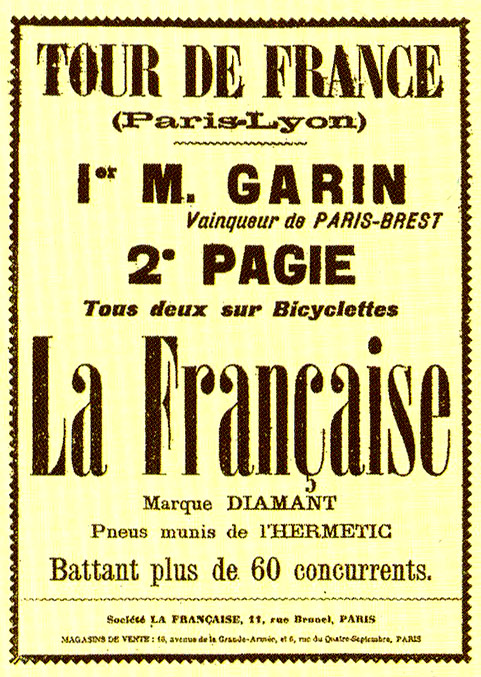
On July 1, 1903, sixty cyclists gathered outside a Paris cafe called Au Reveil Matin just after three in the afternoon. They were about to ride nearly 1,500 miles around France in six stages over nineteen days. No support vehicles, no team radios. Most riders carried spare tires around their shoulders and tools to repair their own bikes. If something broke at two in the morning on a mountain road, you fixed it yourself or went home. On July 19, Maurice Garin crossed the finish line at Parc des Princes in Paris, winning the first Tour de France by nearly three hours.
The race was invented to sell newspapers. Henri Desgrange, editor of L'Auto, needed a publicity stunt to beat a rival paper. His colleague Geo Lefevre suggested a multi-stage race around the entire country. The first stage ran from Paris to Lyon, 467 kilometers through the night. The roads were unpaved. The bikes weighed over 40 pounds, had no gears. Riders climbed mountains on fixed wheels, or walked when the gradient became impossible.
cyclists at the first tour de france, 1903. source: wikimedia commons

Desgrange wanted suffering. He believed sport should test human limits, not display comfort. The race was a commercial success -- L'Auto's circulation doubled. The Tour became an annual tradition, evolving as technology did. Gears arrived. Roads were paved. Support cars followed with spare wheels. But the core remained: divide the impossible into stages, solve one segment at a time.
Modern cyclists train with power meters and wind tunnels. Winning margins are measured in seconds. The suffering remains, but it is calculated -- engineered into the training plan months in advance. The Tour is sport as architecture, built from distance and time, where the materials are human bodies and the question is always the same: how far can you go before you stop?