on-this-day · july 27
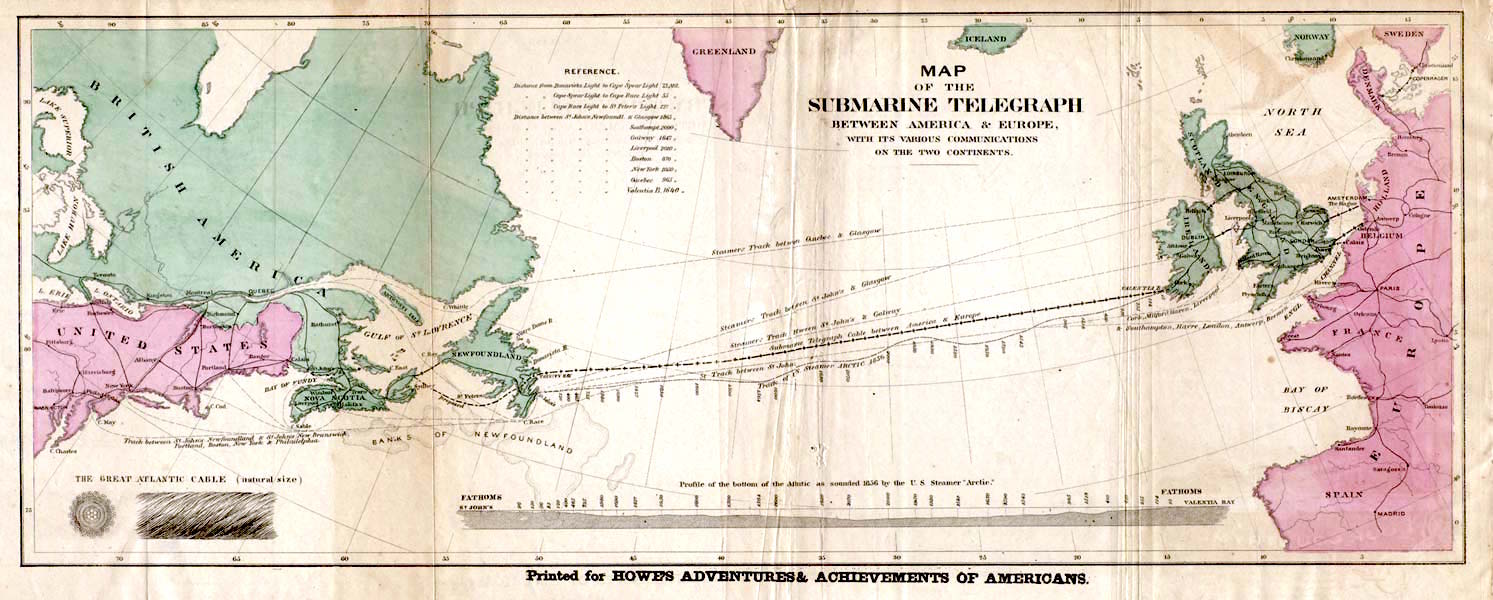
map of the transatlantic telegraph cable route. source: wikimedia commons

The Cable Across the Ocean
On this day in 1866 — The first transatlantic telegraph cable was completed. Two continents connected by copper wire.
2 min read
On July 27, 1866, the Great Eastern finished laying 1,852 miles of insulated copper cable across the Atlantic floor. It stretched from Valentia Island in Ireland to Heart's Content in Newfoundland. When tested, electrical pulses traveled both directions. For the first time, Europe and North America could communicate in minutes instead of weeks.
This was not the first attempt. An 1858 cable worked briefly before failing -- the wire degraded within months, silenced by deep-water pressure and corrosive seawater. Critics said it was impossible. Cyrus West Field, the American entrepreneur behind the project, spent years raising money and designing better cables. His team improved the insulation using gutta-percha layered over the copper core. The Great Eastern, the only ship large enough, was retrofitted to carry the cable.

chart of the submarine atlantic telegraph route. source: wikimedia commons

Laying cable required precision. Too fast and it snaps. Too slow and it piles up. The crew worked around the clock for two weeks. The cable changed how information moved. Before it, news crossed by steamship, weeks behind events. After it, financial markets synchronized. Newspapers reported European events the same day. Communication became infrastructure, a utility as essential as roads.
More cables followed. By century's end, a network connected continents. Telegraph gave way to telephone, then fiber optics carrying terabits per second. The principle remains: information travels through physical connections on the ocean floor. The 1866 cable proved the concept. Distance could be compressed to seconds. Field did not invent the telegraph or design the cable. He organized the project and persisted through failure. Infrastructure requires more than good ideas. It requires the belief that a difficult thing is worth doing even when the first attempt fails.