on-this-day · july 4
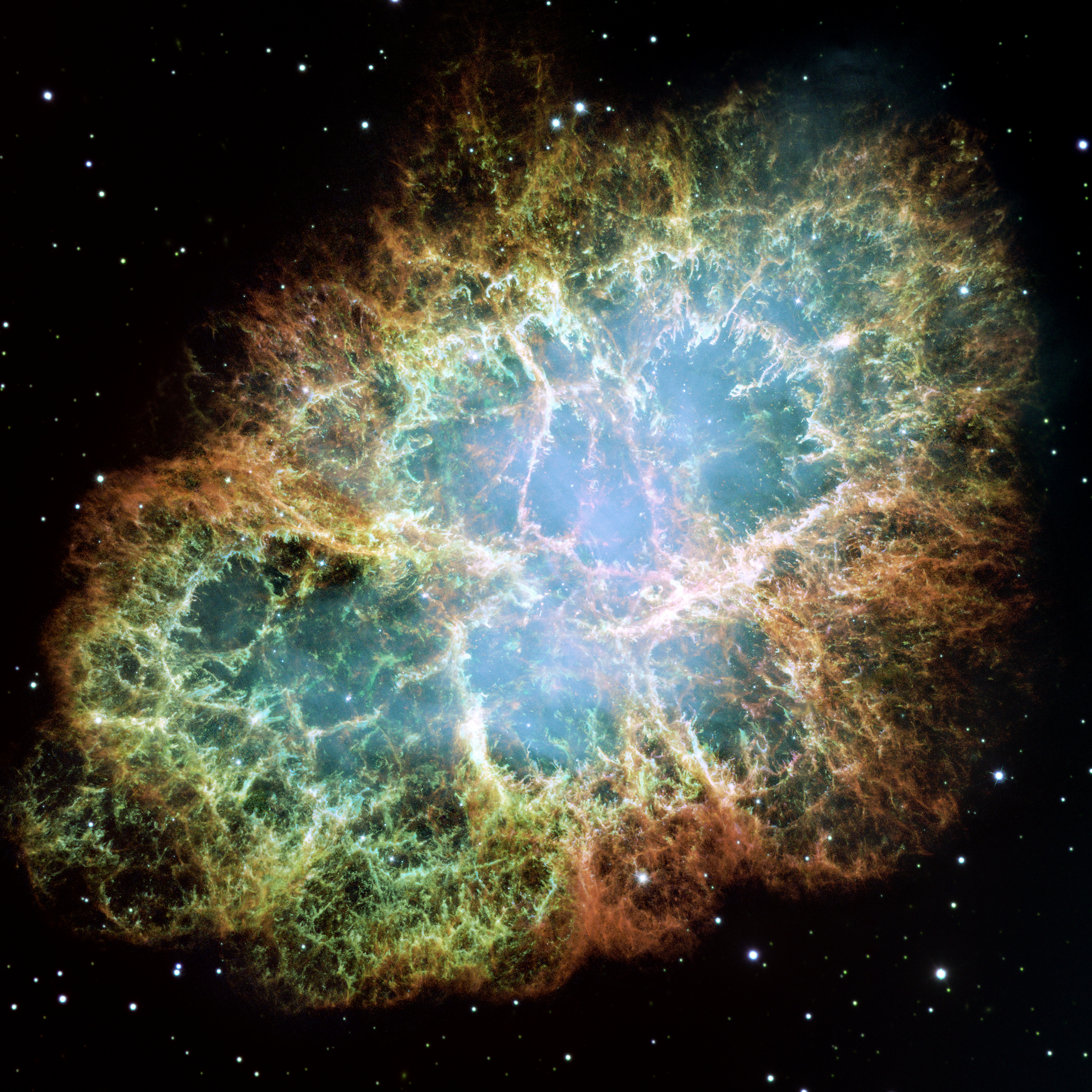
the crab nebula (m1), remnant of the supernova of 1054. source: wikimedia commons

The Guest Star
On this day in 1054 — Chinese astronomers recorded the supernova that created the Crab Nebula. It was visible in daylight.
2 min read
On July 4, 1054, Chinese astronomers observed what they called a "guest star" in the constellation Taurus. It was bright enough to see during the day for nearly a month and remained visible at night for almost two years. They recorded its position with precision, noting it was near the star Tianguan. No one alive understood what they were watching. It was the death of a star, collapsing and then exploding outward with the energy of a hundred million suns.
The star was probably eight to twelve times the mass of our sun. When it burned through its nuclear fuel, the core collapsed into a neutron star -- a sphere about twelve miles across, the mass of the sun compressed into the size of a city. The outer layers were blown away at speeds approaching ten percent the speed of light. That light traveled 6,500 years across space before reaching Earth.

chinese record of the 1054 supernova (sn 1054) from the lidai mingchen zouyi. source: wikimedia commons
_in_the_Lidai_mingchen_zouyi_(%E5%8E%86%E4%BB%A3%E5%90%8D%E8%87%A3%E5%A5%8F%E8%AE%AE).jpg)
The connection between the guest star and what we now call the Crab Nebula was not made until the twentieth century. In 1921, John Duncan compared photographs taken years apart and noticed the nebula was expanding. Running the clock backward, he calculated it had been a single point roughly 900 years earlier. Modern telescopes reveal a pulsar at its center, spinning thirty times per second, emitting radiation like a lighthouse.
What makes this remarkable is that it was recorded at all. The Chinese astronomers had no idea what they were observing, but they wrote it down with enough precision that a millennium later, it could be matched to an object in the sky. That continuity of attention -- the assumption that someone, someday, will make sense of the pattern -- is a kind of faith in the future. They were right.