on-this-day · july 7
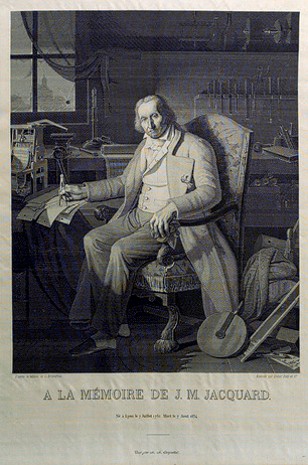
woven silk portrait of joseph marie jacquard — itself made on a jacquard loom using 24,000 punch cards. source: wikimedia commons

Weaving Code
On this day in 1752 — Joseph Jacquard was born. His programmable loom used punch cards. Textiles became computation.
2 min read
Joseph Marie Jacquard was born on July 7, 1752, in Lyon, France, the son of a weaver. He grew up around looms and understood their limitations. Complex patterns required a team of workers manually lifting specific threads in sequence. Slow, expensive, error-prone. What Jacquard eventually invented was not just a better loom but one of the first programmable machines in history.
The Jacquard loom, demonstrated in 1801, used a chain of punched cards to control which threads were lifted during weaving. Each card represented one row of the pattern. Holes allowed certain hooks to pass through, lifting specific warp threads. The cards could be swapped out, allowing the same loom to produce different patterns by changing the program. The loom became general-purpose hardware. The cards became software.

punch cards used to program a jacquard loom. source: wikimedia commons

Weavers rioted. Their looms were smashed. But the technology was too useful to suppress. In the 1830s, Charles Babbage saw one in operation and realized punch cards could control a calculating machine. Ada Lovelace, working with Babbage, wrote what is often credited as the first computer algorithm.
Punch cards became the standard for programming and data storage in early computers. Herman Hollerith used them to tabulate the 1890 U.S. Census. IBM built its empire on punch card systems. The connection between weaving and computing is direct and unbroken. Jacquard did not set out to invent the foundation of computer science. He just wanted to make better fabric. But the tool he designed to automate looms turned out to automate thought itself.