on-this-day · august 26
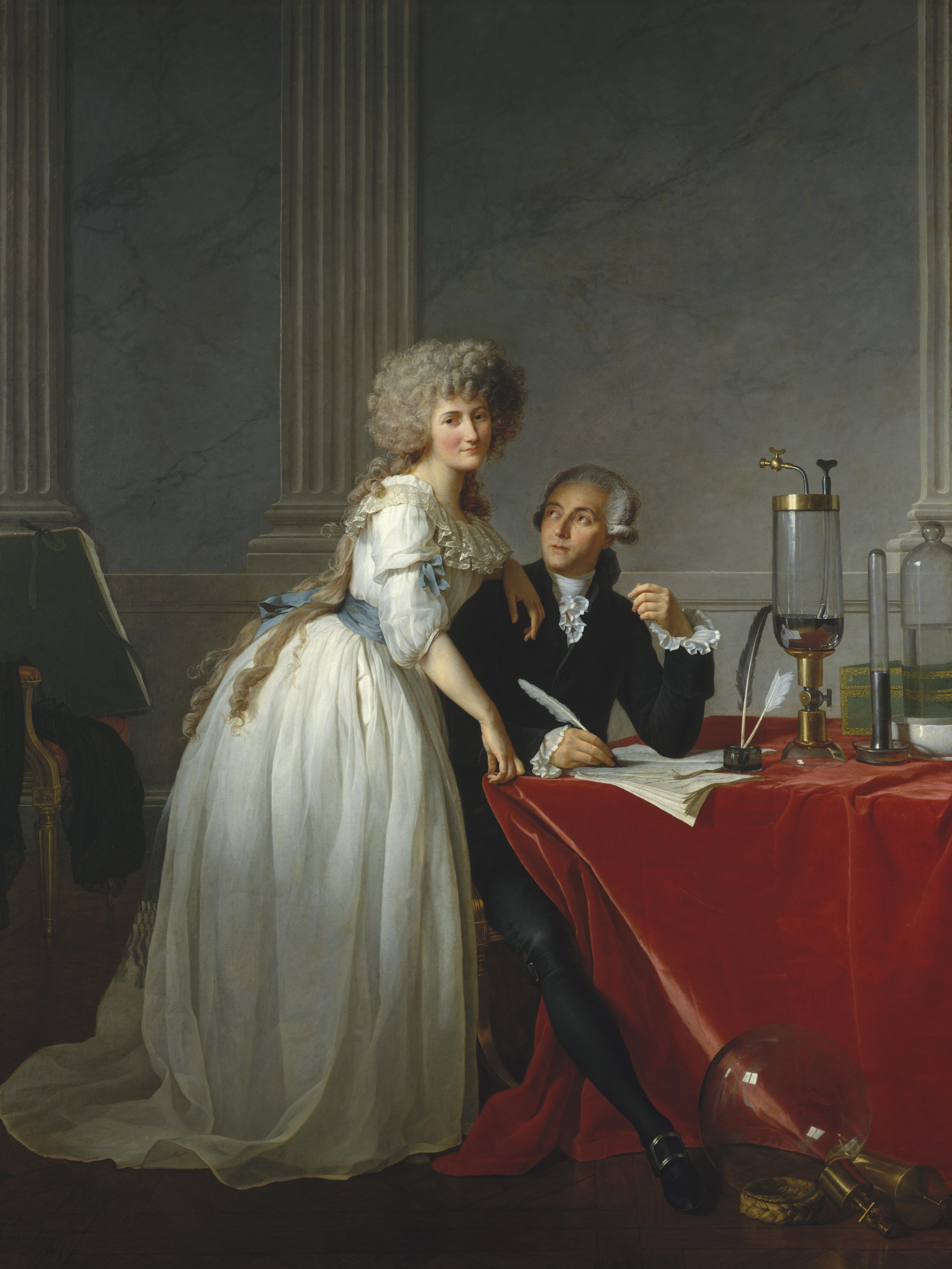
antoine-laurent lavoisier and marie-anne lavoisier, painted by jacques-louis david, 1788. source: wikimedia commons

The Man Who Named the Air
On this day in 1743 — Antoine Lavoisier was born. He named oxygen and hydrogen and redesigned chemistry from scratch.
2 min read
Antoine Lavoisier was born on August 26, 1743, in Paris. He would dismantle alchemy and build chemistry in its place. Before Lavoisier, the dominant theory of combustion was phlogiston -- an invisible substance supposedly released when things burned. Elegant, widely accepted, and completely wrong. Lavoisier proved it with precise measurement.
His key insight: combustion is not release but combination. Things don't lose phlogiston when they burn. They gain oxygen. He demonstrated this by weighing materials before and after combustion, showing total mass was conserved. Matter is not created or destroyed -- it is rearranged. This principle became the foundation of modern chemistry.
Lavoisier named oxygen and hydrogen. He wrote the first modern chemistry textbook in 1789. He created a systematic naming convention for compounds still used today. He identified 33 elements. Before him, chemistry was recipes and traditions. After, it was a science with rules.
He also proved metabolism was chemistry. Working with Laplace, he measured heat from a guinea pig's respiration and showed it was slow combustion. The body was a machine running on oxidation.
Lavoisier was also a tax collector, which made him enemies. During the Revolution, the tribunal arrested him. On May 8, 1794, he was guillotined. Lagrange reportedly said: "It took them only an instant to cut off his head, and one hundred years might not suffice to reproduce its like."

liquid oxygen — the element lavoisier named and identified as essential to combustion. he showed that burning was not the release of phlogiston but the combination of a substance with oxygen from the air. source: wikimedia commons

His real contribution was methodological. Weigh everything. Record everything. Let the numbers speak. Chemistry before Lavoisier was storytelling. After him, it was engineering. He designed a system for discovering elements.