on-this-day · august 31
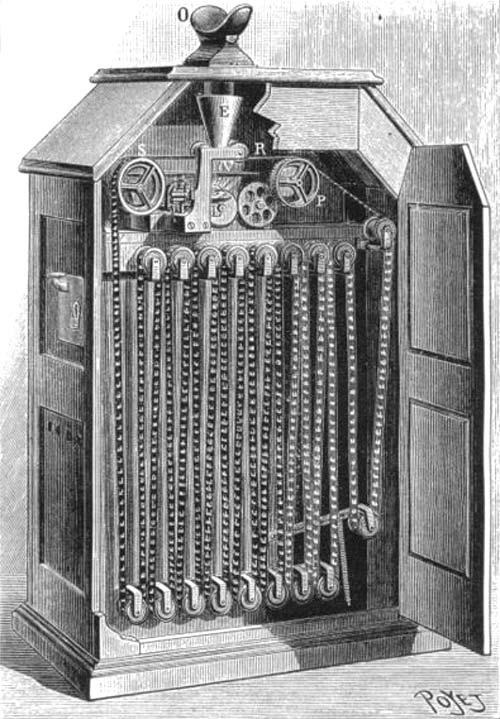
an edison kinetoscope, the cabinet through which one person at a time could watch moving pictures. source: wikimedia commons

One Person at a Time
On this day in 1897 — Thomas Edison patented the kinetoscope. Moving pictures became a personal experience.
2 min read
On August 31, 1897, Thomas Edison received patent 589,168 for the kinetoscope, a device for viewing moving pictures. Filed six years earlier, the patent covered the kinetographic camera. Edison and assistant W.K.L. Dickson had been developing the technology since 1889, initially hoping to combine moving images with the phonograph. Unable to synchronize sound and picture, they focused on images alone.
The kinetoscope was a peephole viewer. One person looked through an opening atop a wooden cabinet to watch a short film loop. Not a projector -- a private experience, moving pictures for an audience of one. Edison believed individual viewing would be more profitable than projection. He was wrong, but the technology made projection possible.
Films were shot in the Black Maria, a tar-paper studio built in 1893 that rotated to follow the sun. Subjects included vaudeville performers, boxers, and dancers. Each film lasted about 20 seconds. The content was simple. The technology was the spectacle.
Kinetoscope parlors opened in New York, Chicago, and San Francisco in 1894. A nickel bought a short loop. The novelty faded fast. But the Lumiere brothers in France developed projection for audiences. Edison eventually pivoted too.

auguste and louis lumière, the brothers who saw the limitations of edison's kinetoscope and invented the cinematographe — projection for a shared audience — within months, holding their first public screening in paris in december 1895. source: wikimedia commons

His decision not to seek international patents was consequential -- it let European inventors study and improve the technology freely. The global film industry grew partly because Edison didn't protect his work overseas. The kinetoscope proved that sequential photographs, displayed rapidly, create the illusion of motion. That principle underlies every screen you've ever watched. Edison saw a novelty. Others saw an art form. The patent was for a box with a peephole. What emerged from it was cinema.