on-this-day · september 16

the mayflower on her arrival in plymouth harbor, painting by william formby halsall. source: wikimedia commons

A Small Vessel Carrying a Prototype Civilization
On this day in 1620 — the Mayflower departed from Plymouth, England. A small vessel carrying a prototype civilization.
2 min read
On September 16, 1620, a merchant ship named the Mayflower slipped away from Plymouth, England, carrying 102 passengers and about 30 crew. The vessel was 110 feet long. It was built for wine, not pilgrims -- its timbers had soaked up enough French wine residue that the smell permeated the lower decks where passengers lived in near darkness for 66 days.
The passengers were religious separatists escaping persecution. They had already tried exile in the Netherlands for over a decade, but worried their children were becoming too Dutch. This was not the original plan either. The Mayflower had set out with a second ship, the Speedwell, which leaked twice and was abandoned. The Mayflower departed alone, overloaded.
The voyage was brutal. Storms cracked a main beam mid-ocean. One passenger was swept overboard and managed to grab a trailing rope. Another died. A child was born and named Oceanus. When they sighted land on November 21, they were nowhere near their destination -- storms had pushed them to Cape Cod, outside any colonial jurisdiction.
This created a legal problem. With no governing authority, 41 adult male passengers drafted the Mayflower Compact -- a practical agreement to form a "civil body politic" and abide by laws for the common good. It was design thinking applied to statecraft, written out of necessity in the cramped quarters of a wine-soaked merchant vessel.
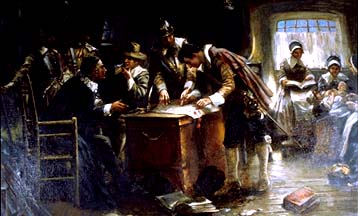
the signing of the mayflower compact — the document that created self-governance from necessity. source: wikimedia commons

Roughly half the passengers died during the first winter. The Mayflower returned to England carrying wine. It was never famous in its time. What mattered was the fragile social architecture its passengers built while still aboard. A civilization is just a set of agreements about how to organize collective survival. Sometimes those agreements are scrawled on a ship with winter approaching and no guarantee of survival.