on-this-day · october 19

the horse in motion, eadweard muybridge, 1878. source: wikimedia commons

The Moment Between Steps
On this day in 1872 — The Eadweard Muybridge photograph of a horse in motion proved all four hooves leave the ground.
2 min read
For as long as humans had painted horses, they had been getting the motion wrong. Artists depicted galloping horses with front legs stretched forward and back legs behind, like rocking horses frozen mid-swing. Nobody questioned it because nobody could see fast enough to know otherwise. Then, on October 19, 1878, Scientific American published Eadweard Muybridge's photographs on its cover, and the debate was settled.
The photographs had been taken months earlier at Leland Stanford's Palo Alto racetrack. Stanford hired Muybridge to answer a simple question: does a galloping horse ever have all four hooves off the ground? Muybridge set up cameras along the track, each triggered by a thread as the horse passed. The sequence proved that yes, all four hooves leave the ground -- but not in the dramatic pose artists had imagined. The horse tucked its legs beneath its body.
eadweard muybridge's "the horse in motion," 1878. source: wikimedia commons
The photographs did more than settle a bet. They revealed that human perception is unreliable at speed. Our eyes cannot track fast motion accurately. We fill in gaps with assumptions, and those assumptions are often wrong. Muybridge's work was the first systematic use of photography to capture what the eye cannot see -- stop-motion analysis that would later become essential to science, engineering, and medicine.
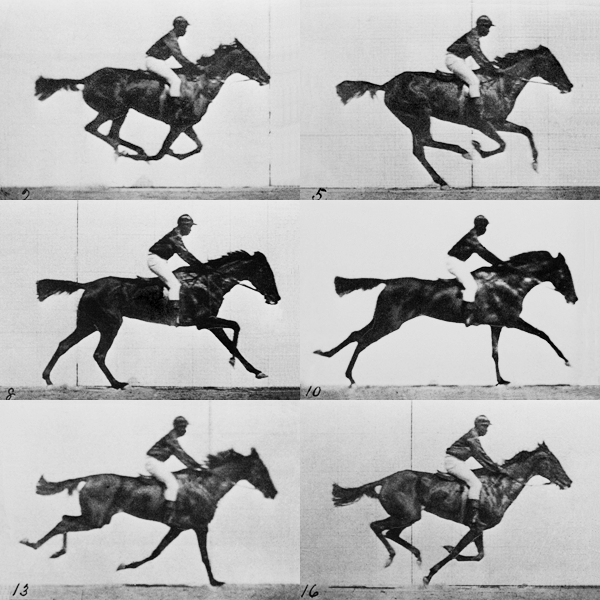
animated sequence from muybridge's series of photographs of a horse in motion, 1878. source: wikimedia commons

Muybridge went further. He invented the zoopraxiscope, projecting sequential images to create the illusion of motion -- a direct ancestor of cinema. From horse photography to Hollywood in a few conceptual steps. October 19, 1878, is the day we learned that seeing is not believing. A camera could show us what our eyes could not. Every frame of every film owes something to a man who pointed a camera at a horse and proved reality moves differently than we think.