on-this-day · november 16

john ambrose fleming, circa 1890. source: wikimedia commons

The Valve That Opened the Electronic Age
On this day in 1904 — John Ambrose Fleming patented the vacuum tube. The ancestor of every transistor.
2 min read
On November 16, 1904, John Ambrose Fleming filed a patent for his oscillation valve -- a glass bulb with two electrodes, evacuated of air, that allowed current to flow in only one direction. He built it for the Marconi Company to convert alternating radio signals into decodable direct current. He was fifty-five, a professor at University College London, and had no idea he was building the foundation of electronics.
The insight came from the Edison Effect. When a filament heated inside a vacuum bulb, it released electrons captured by a positively charged plate. One-way flow. A valve for electricity. Fleming saw the application: detecting and rectifying radio signals with no mechanical parts. Heat a cathode, place an anode nearby, remove the air. Electrons fly or they don't. Binary.
Within years, Lee de Forest added a third electrode -- the grid -- creating the triode and turning the valve into an amplifier. Radio could span continents. Telephones could cross oceans. Vacuum tubes built everything: radios, televisions, radar, computers. The ENIAC used 17,468 of them and weighed 30 tons. Every calculation humanity made until the late 1950s passed through glass bulbs filled with nothing.
The transistor replaced Fleming's valve but kept its logic: control electron flow, open or close the gate. Every chip in every device contains billions of transistors, each descended from Fleming's glass bulb. Emptiness, carefully controlled, carrying everything.
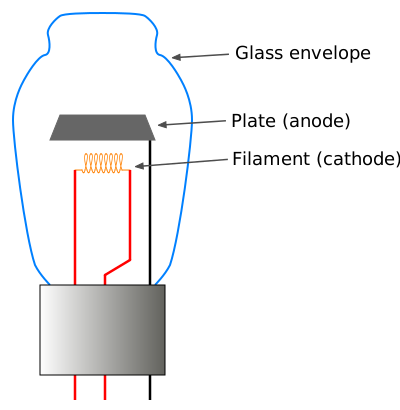
diagram of a diode vacuum tube — the principle behind fleming's original oscillation valve. source: wikimedia commons
