on-this-day · december 30

edwin hubble at the mount wilson observatory. source: wikimedia commons

The Universe Gets Bigger
On this day in 1924 — Edwin Hubble announced that the Milky Way is not the only galaxy. The universe got infinitely larger.
2 min read
On December 30, 1924, Edwin Hubble announced to the American Astronomical Society that the Andromeda Nebula was not a cloud of gas within the Milky Way. It was a separate galaxy, roughly 900,000 light-years away. The universe, which most astronomers believed consisted of a single galaxy, was suddenly vastly larger than anyone had imagined.
Hubble proved this using Cepheid variable stars -- stars whose brightness fluctuates in a regular pattern correlated with their actual luminosity. By measuring the period of Cepheids in Andromeda and comparing their apparent brightness to their known luminosity, Hubble calculated the distance. The number was far beyond the Milky Way's estimated size. Andromeda had to be its own galaxy.
The result settled the "Great Debate" that had divided astronomy. In 1920, Harlow Shapley argued that the Milky Way was the entire universe. Heber Curtis argued that spiral nebulae were separate galaxies. Hubble's measurement proved Curtis right. The Milky Way was one galaxy among billions.
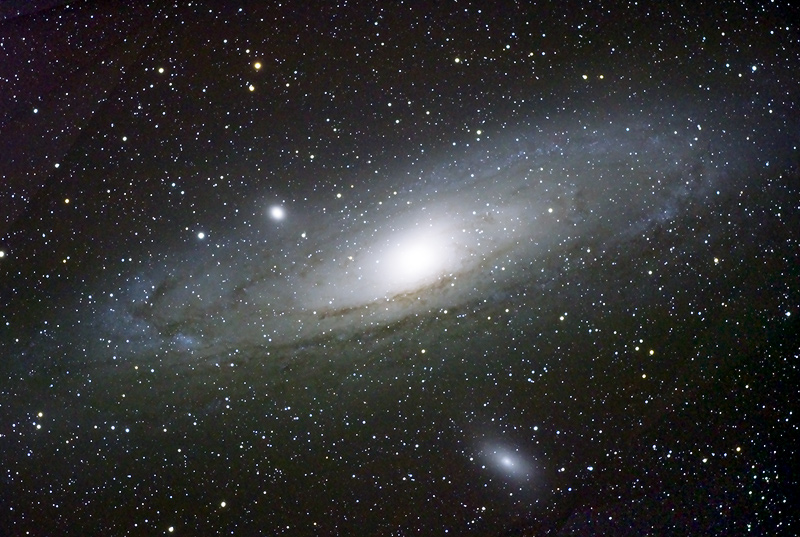
the andromeda galaxy, approximately 2.5 million light-years away. source: wikimedia commons

Hubble went further. By the late 1920s, he demonstrated that galaxies are moving away from each other -- the universe is expanding. This observation led directly to the Big Bang theory. Carl Sagan would later remind us of our smallness in this expanded cosmos.
Before Hubble's announcement, the universe was one galaxy. After it, the universe was everything. One measurement, one star's flicker, and the scale of reality changed forever. Hubble didn't discover new territory. He discovered that territory was infinite.