on-this-day · april 24
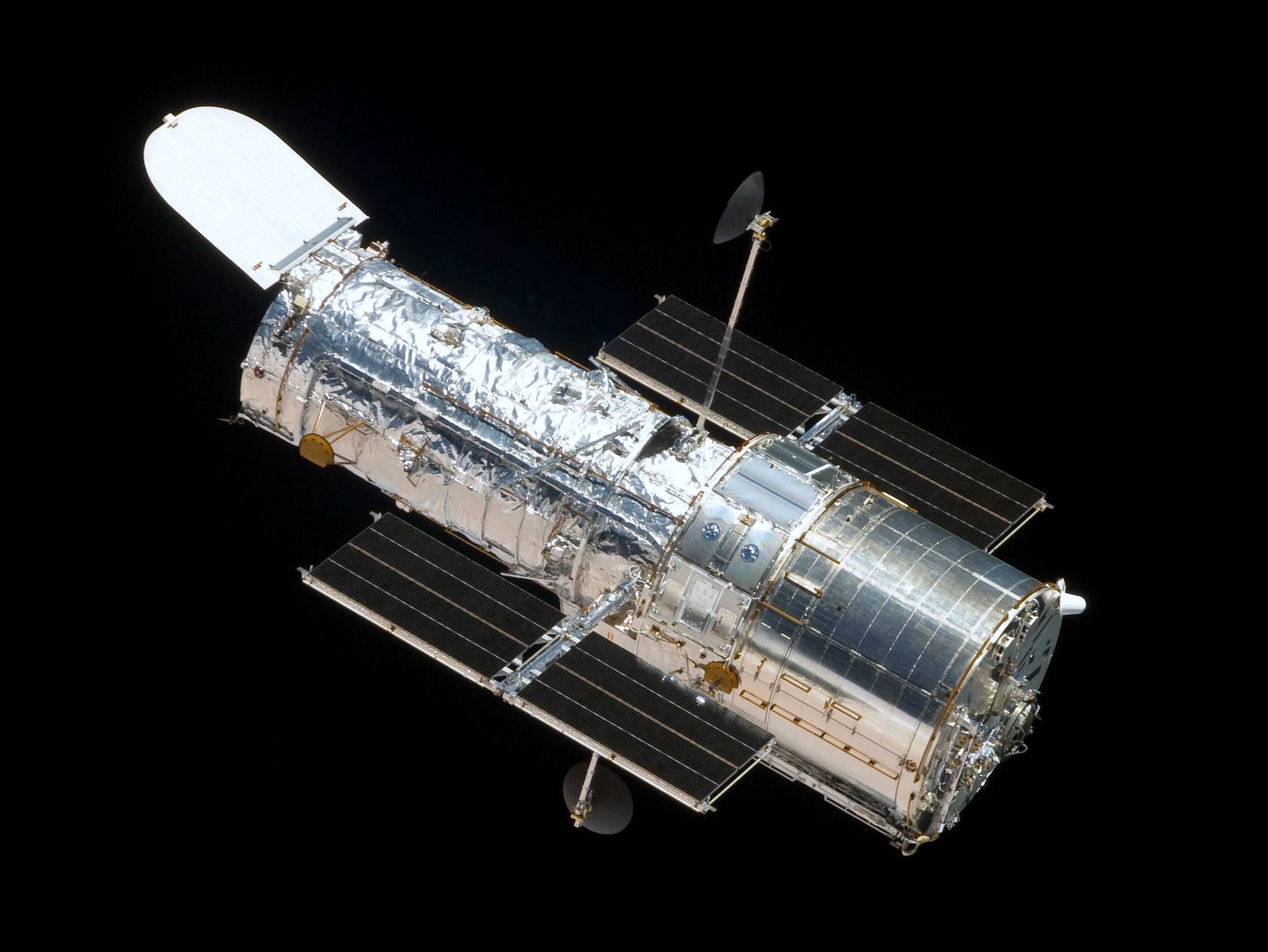
the hubble space telescope photographed during servicing mission 4 in 2009. hubble was deliberately placed in low earth orbit where astronauts could reach it — built not for perfection but for maintenance. source: wikimedia commons

Seeing Through the Flaw
On this day in 1990 — The Hubble Space Telescope was launched. A mirror with a flaw that still showed us the universe.
2 min read
On April 24, 1990, the shuttle Discovery carried the Hubble Space Telescope into orbit. It was the size of a school bus, weighed eleven tons, and cost over $1.5 billion. Within weeks, scientists realized the images were blurry. The primary mirror, polished to within a millionth of an inch, was the wrong shape — too flat at the edges by 2.2 microns, about one-fiftieth the width of a human hair.
The flaw was caused by miscalibrated testing equipment during manufacturing. The press called it a disaster. After decades and billions, the most advanced telescope ever built couldn't focus.
What saved Hubble was designing a fix for the flaw. In 1993, astronauts installed corrective optics — essentially eyeglasses for a telescope. Five spacewalks over eleven days. When the corrected images arrived, they were flawless.

the hubble extreme deep field (2012), a composite of ten years of exposures totaling two million seconds of observation time. nearly every object in the image is an entire galaxy. source: wikimedia commons
.png)
What Hubble has shown us since is difficult to overstate. The Deep Field images revealed thousands of galaxies in a patch of sky the size of a pinhead at arm's length. It confirmed dark energy, captured stellar nurseries and dying stars, and measured the age of the universe. Every major astronomy textbook in the last 30 years is filled with Hubble's images.
Hubble was built to be serviced — placed in low orbit where shuttles could reach it. Astronauts upgraded instruments five times over two decades, replacing cameras, gyroscopes, and batteries. A telescope designed in the 1970s was still doing cutting-edge science in the 2020s because it was built to evolve. Perfection is optional. Adaptability is not. A flawed mirror, corrected in orbit, gave humanity the clearest view of the universe it has ever had.