on-this-day · april 25

diagram of the dna double helix with labeled components. the specific base pairing — adenine with thymine, guanine with cytosine — is the key to the molecule's ability to copy itself. source: wikimedia commons

900 Words That Decoded Life
On this day in 1953 — Watson and Crick published the structure of DNA in Nature. 900 words that decoded life.
2 min read
On April 25, 1953, Nature published a one-page paper: "Molecular Structure of Nucleic Acids." James Watson and Francis Crick described DNA as a double helix — two strands wound like a twisted ladder. The paper was 900 words. It ended with one of science's most understated sentences: "It has not escaped our notice that the specific pairing we have postulated immediately suggests a possible copying mechanism for the genetic material."
The discovery wasn't theirs alone. Rosalind Franklin at King's College London had produced Photo 51, the clearest X-ray image of DNA's helical structure. Watson saw it without her permission and used it to confirm their model. Franklin died in 1958. Watson and Crick shared the 1962 Nobel with Maurice Wilkins. Franklin's contribution was acknowledged only in retrospect.
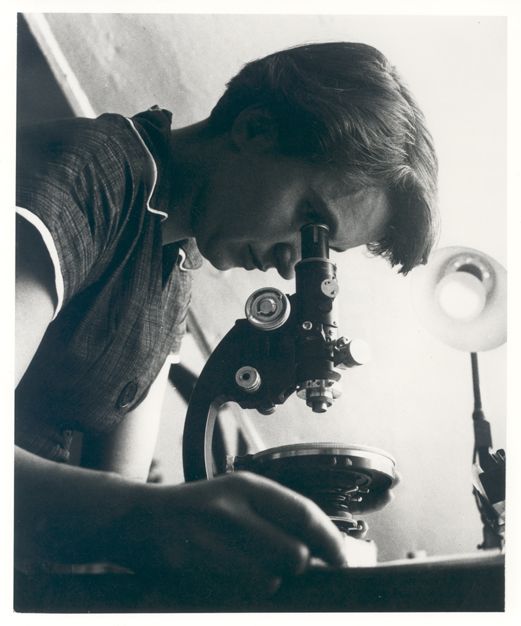
rosalind franklin, whose x-ray diffraction photograph of dna — photo 51 — provided the critical evidence watson and crick used to build their model. she died in 1958 and was never nominated for the nobel prize. source: wikimedia commons

What they figured out wasn't just shape — it was logic. DNA's four nucleotides pair specifically: adenine with thymine, guanine with cytosine. Know one strand, deduce the other. The molecule carries its own replication instructions. Unzip the helix, and each strand templates a new partner. The structure explained the function.
The implications unfolded over decades. DNA is code written in four letters, read in groups of three. Each group specifies an amino acid. Amino acids form proteins. Proteins do everything in a cell. Life is software running on biochemical hardware. The Human Genome Project mapped all three billion base pairs by 2003 at a cost of $2.7 billion. Today you can sequence a genome for a few hundred dollars.
Once you understand DNA as code, you can edit it. CRISPR allows precise changes to genetic sequences — removing disease genes, engineering crop resistance, potentially designing organisms from scratch. Watson and Crick's 900-word paper opened a door. We're still deciding what to do with the room on the other side.