on-this-day · april 28
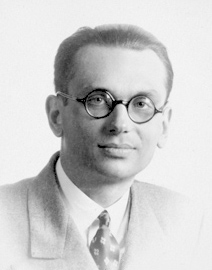
kurt gödel, whose incompleteness theorems demonstrated that in any sufficiently powerful formal system, there exist true statements that cannot be proven within that system. he published the proof at age 25. source: wikimedia commons

The Limits of Proof
On this day in 1906 — Kurt Gödel was born. He proved that every logical system has truths it cannot prove about itself.
2 min read
Kurt Gödel was born on April 28, 1906, in Brünn, Austria-Hungary. He studied mathematics at the University of Vienna and joined the Vienna Circle, a group trying to build a rigorous foundation for all knowledge using logic. Their project: reduce every truth to a proof, formalize all reasoning, eliminate ambiguity. Gödel destroyed that ambition at 25.
In 1931, he proved that in any sufficiently complex logical system, there exist statements that are true but cannot be proven within the system. Worse, no such system can prove its own consistency. This is the first incompleteness theorem, and it shattered the dream of a complete mathematical framework.

kurt gödel as a student in 1925, six years before he would publish the incompleteness theorems at age 25. he was a member of the vienna circle, whose dream of a complete logical foundation for all knowledge his work would destroy. source: wikimedia commons

The proof turns logic on itself. Gödel assigned numbers to every symbol and proof, then constructed a statement: "This statement cannot be proven." If false, the system proves false things — inconsistent. If true, the system can't prove it — incomplete. A logical trap with no escape.
Alan Turing, building on Gödel's work, proved there's no general algorithm to determine whether any program will halt or run forever. The halting problem is undecidable. Any set of rules — any protocol, specification, or legal code — is a formal system. If complex enough, it will contain edge cases unresolvable by the rules themselves. This is why legal codes have courts, software has maintainers, and protocols have governance. The rules alone are never enough.
Gödel became increasingly paranoid, believing people were poisoning him. He died of starvation in 1978, weighing 65 pounds. What remains is the theorem — not a negative result, but a clarification. You cannot build a system that answers every question. You can build systems useful and reliable within limits. The limits are real. Gödel proved it.