on-this-day · may 22

arthur conan doyle photographed by herbert rose barraud, 1893, the year he killed off sherlock holmes. source: wikimedia commons

The Logic Machine
On this day in 1859 — Arthur Conan Doyle was born. He designed Sherlock Holmes, literature's greatest reasoning engine.
2 min read
Arthur Conan Doyle was born in Edinburgh on May 22, 1859, into a family of artists and illustrators. His father was a chronic alcoholic who spent much of his later life institutionalized. Doyle went to medical school, struggled to build a practice, and began writing fiction to supplement his income. In 1887, he published A Study in Scarlet, introducing the world to Sherlock Holmes and Dr. John Watson. He had no idea he had just created the most famous fictional character of the modern era.
Holmes was not the first literary detective, but he was the first designed as a reasoning engine. Doyle based him partly on Dr. Joseph Bell, a surgeon at the University of Edinburgh known for his powers of observation and deductive reasoning. Holmes does not solve crimes through luck or intuition. He observes details others miss, eliminates impossible explanations, and arrives at the truth through a process that is explicitly logical. "When you have eliminated the impossible, whatever remains, however improbable, must be the truth."
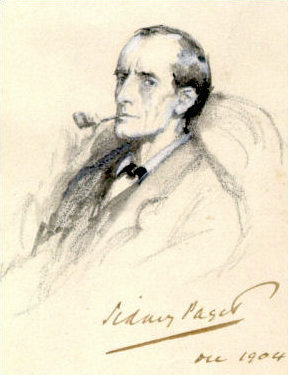
sidney paget's iconic illustration of sherlock holmes, published in the strand magazine, 1891. source: wikimedia commons

Doyle grew to resent Holmes. He wanted to be known for his historical novels, not detective stories. In 1893, he killed Holmes off at the Reichenbach Falls. Public outrage was so intense that Doyle eventually brought him back. The character had become bigger than its creator -- a cultural phenomenon that generated fan fiction, theatrical adaptations, and an entire genre of detective fiction built on Holmes's method.
The irony is that Doyle himself was credulous where Holmes was skeptical. He believed in fairies, attended seances, and championed spiritualism for the last decade of his life. The man who designed literature's greatest reasoning engine was, in his personal life, remarkably willing to believe the impossible. Holmes would not have approved.