on-this-day · june 26

lord kelvin (william thomson), physicist and engineer who defined absolute zero and the kelvin temperature scale, photographed in 1906. source: wikimedia commons

The Bottom of the Scale
On this day in 1824 — William Thomson, Lord Kelvin, was born. He defined absolute zero and gave temperature a floor.
2 min read
William Thomson was born in Belfast on June 26, 1824, into a family that valued education fiercely. His father, a mathematics professor, taught his children advanced calculus before they were teenagers. William entered the University of Glasgow at age 10. By 22, he was a professor of natural philosophy there, a position he would hold for 53 years.
In 1848, he proposed an absolute temperature scale based on a fundamental physical limit: the point at which all molecular motion ceases. He set absolute zero at minus 273.15 degrees Celsius. The Kelvin scale starts at zero with no negative numbers. It was not a convenience. It was a conceptual tool that made thermodynamic equations work cleanly. Celsius and Fahrenheit are arbitrary, tied to water. Kelvin made temperature a measurement of energy, not sensation.
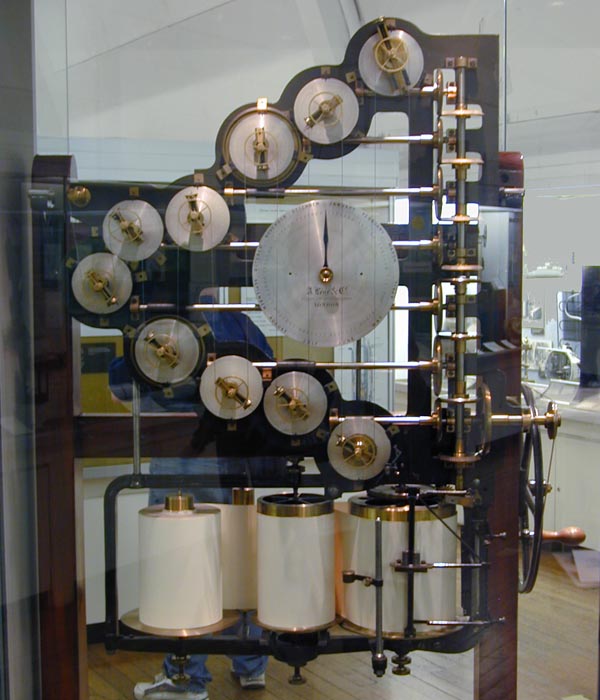
thomson's tide predicting machine -- lord kelvin designed this analog computer to calculate tidal patterns, one of many practical inventions alongside his theoretical work. source: wikimedia commons

Thomson's contributions went far beyond temperature. He solved the mathematical and engineering problems that made the first transatlantic telegraph cable viable. When it finally worked in 1866, messages that took weeks by ship arrived in minutes. He was knighted and later elevated to Baron Kelvin of Largs, taking his title from the River Kelvin near the University of Glasgow.
He was also wrong about many things. He calculated the Earth's age at 20 to 40 million years -- far younger than the billions indicated by geology. He dismissed radioactivity as a heat source. He was skeptical of X-rays and radio waves. Late in life, he argued against atomic theory. Thomson died in 1907, holding over 70 patents and 600 papers. His legacy is complicated -- some ideas foundational, others obstacles to be overcome. What remains clearest is his insistence that measurement must be rigorous, units based on physical reality, and the laws of thermodynamics are not negotiable.