on-this-day · july 17

willis carrier, inventor of modern air conditioning, circa 1915. source: wikimedia commons

Engineering the Weather
On this day in 1902 — Willis Carrier designed the first modern air conditioning system. Climate became a setting.
2 min read
On July 17, 1902, a 25-year-old engineer named Willis Carrier drew a machine that would change where humans could live. He was solving a production problem at a printing plant in Brooklyn, where humidity caused paper to expand and contract, making color alignment impossible. Carrier designed a system that controlled not just temperature but moisture. He called it an apparatus for treating air. We call it air conditioning.
The solution involved chilled coils that cooled air below its dew point, condensing moisture out like water on a cold glass. The air passed through the coils, dried, and was reheated to a precise temperature. For the first time, indoor humidity could be held at a specific percentage regardless of external weather. Carrier filed for a patent in 1904 and received it in 1906.
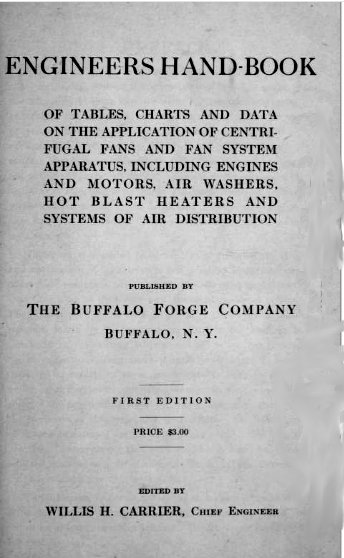
carrier's rational psychrometric formulae, the engineering handbook that codified air conditioning science. source: wikimedia commons

The real transformation came when air conditioning moved from factories to public spaces. Movie theaters were early adopters -- people went for the temperature, not the films. By the 1950s, residential AC arrived. Cities like Phoenix and Houston, previously limited by climate, became metropolises. The Sun Belt exists because Carrier solved a printing problem. Just as Henry Ford's assembly line made automobiles accessible, air conditioning made entire regions habitable.
There is a cost. Air conditioning consumes around 10 percent of global electricity. It makes certain climates livable while contributing to the warming that makes them less so. The machine designed to control indoor weather is now one of the reasons outdoor weather is harder to predict. Systems designed to solve one problem often create another at a different scale.