on-this-day · august 14

page from the mainz psalter, 1457. source: wikimedia commons

The First Color Print
On this day in 1457 — The first known color printing was produced, using a psalter in Mainz, Germany.
2 min read
On August 14, 1457, the Mainz Psalter was completed -- the first book printed with multiple colors. Johann Fust and Peter Schoffer used movable type with colored inks applied to specific letters. Red and blue initials stood out against black text, creating visual hierarchy that guided the eye. This was not hand-illumination. It was mechanical reproduction in color. Every copy identical. The Mainz Psalter proved the printing press could design for visual impact.
Gutenberg had introduced movable type just two years earlier with his 42-line Bible, but using only black ink. Fust and Schoffer, who had worked with Gutenberg before a bitter legal dispute ended their partnership, pushed further. They developed a method to print multiple colors in a single pass by inking specific sections differently. Registration had to be perfect. If it was off, colors would blur. That it worked at all was an achievement.
The Psalter was a luxury object, only a few dozen copies printed. But its significance was the proof of concept. Color printing was possible. Information could be layered visually. The red initials were not decoration -- they were navigational, telling the reader where to start, where to pause.
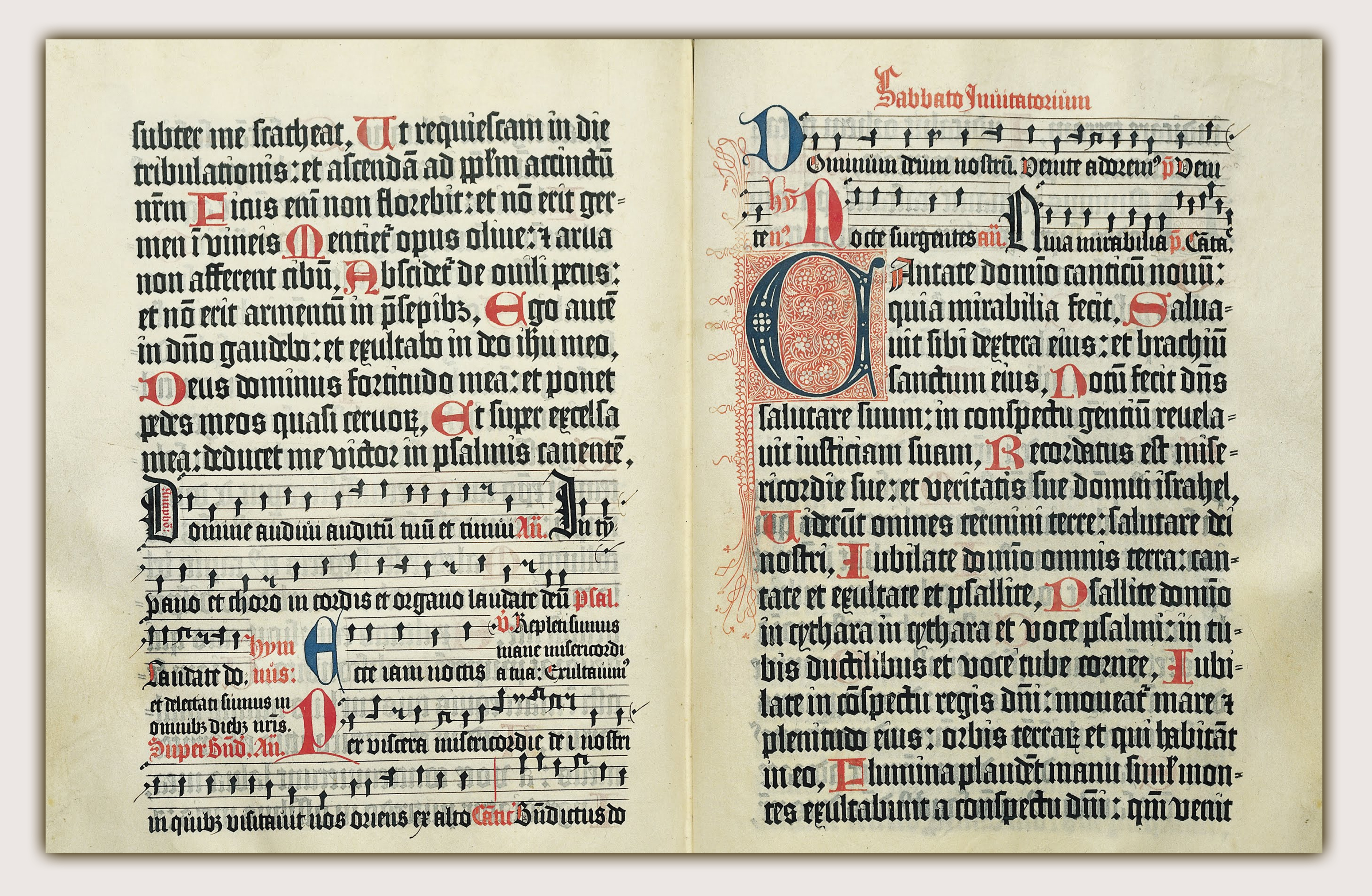
a page from the mainz psalter (1457), the first book printed with multiple colors using mechanical movable type, produced by johann fust and peter schoffer. source: wikimedia commons
_-_Mainz_Psalter_-_Google_Art_Project.jpg)
Color printing evolved slowly. For centuries, most printed material stayed black and white. It took until the 19th century for multi-color printing to become practical at scale. By the 20th century, color was everywhere.
The Mainz Psalter sits in libraries now, fragile and rare. But the principle endures. Color is information. It creates hierarchy, directs attention, conveys emotion. Every website, every app uses color to guide the user, just as Fust and Schoffer used red and blue to guide the reader. Design is not just what something looks like. It is how it works. In 1457, color became part of how printed pages worked.