on-this-day · september 12

the luna 2 spacecraft. source: wikimedia commons

The Controlled Crash That Reached the Moon
On this day in 1959 — Luna 2 became the first human-made object to reach the moon. It crashed on purpose.
2 min read
On September 12, 1959, the Soviet Union launched Luna 2, a 390-kilogram sphere covered in antennas and instruments, toward the moon. Two days later, on September 14, it impacted the lunar surface east of Mare Imbrium at over 3,300 meters per second. No landing gear, no parachute. Luna 2 was designed to crash. For the first time, a human-made object had touched another celestial body.
The mission was simple by modern standards but staggering in 1959. Luna 2 carried instruments measuring radiation, magnetic fields, and micrometeorite impacts during its 36-hour flight. It confirmed the moon had no significant magnetic field. But the science was secondary. The real achievement was navigation -- hitting a moving target 240,000 miles away with a rocket traveling thousands of miles per hour.
Before impact, Luna 2 released two metal spheres engraved with the Soviet coat of arms. They were designed to scatter pentagonal fragments across the lunar surface upon impact -- propaganda embedded in the moon itself. The timing was deliberate: Soviet Premier Khrushchev was preparing to visit the United States and brought a replica as a gift for Eisenhower.
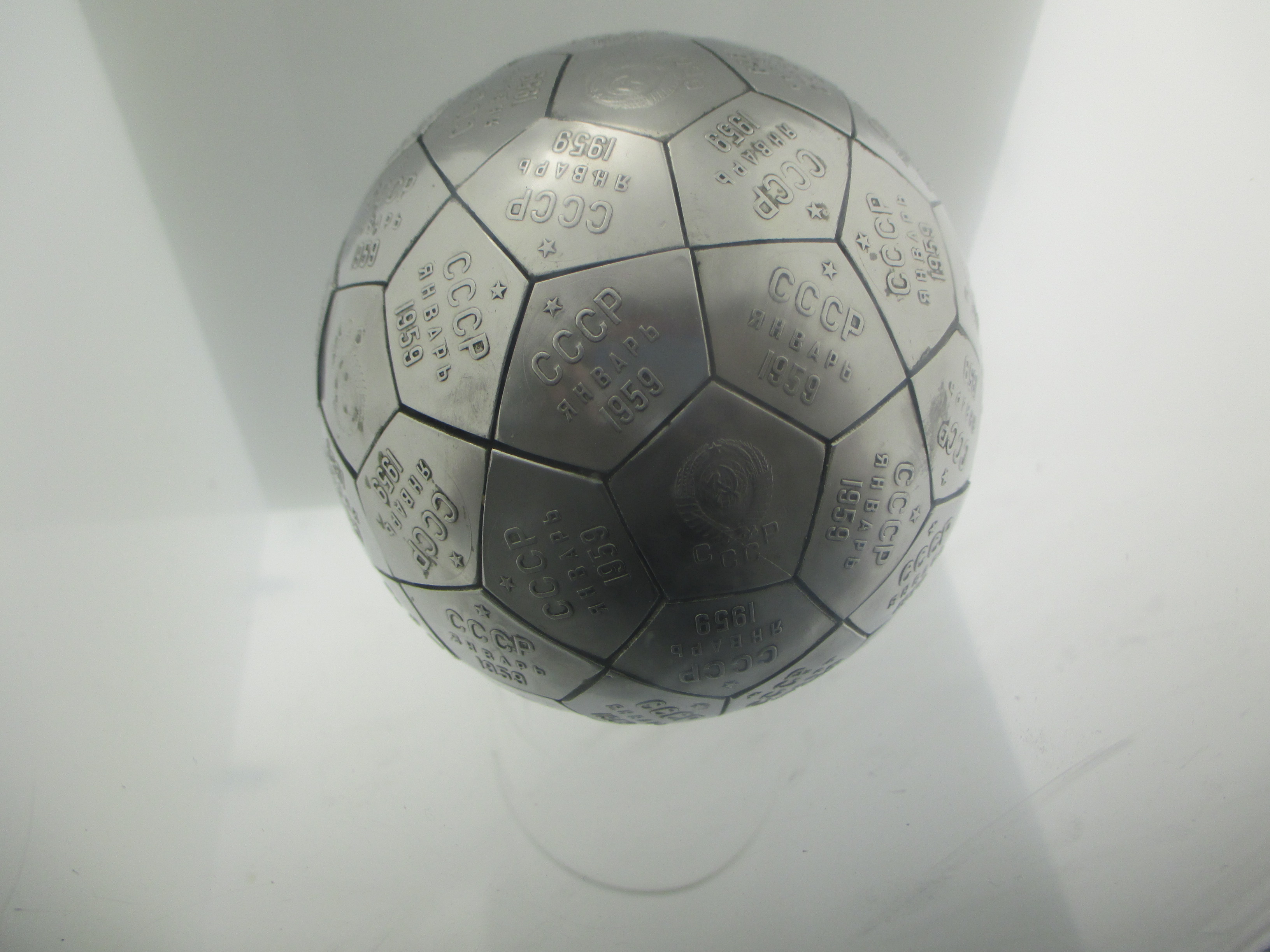
replica of the soviet pennant carried by luna 2 — engraved with the ussr coat of arms and scattered across the lunar surface on impact. source: wikimedia commons

The impact was not observed. No camera on Luna 2, no telescope that could see the crash. Confirmation came from the sudden cessation of the radio signal at the predicted time. The mathematics worked.
Luna 2 is still there, or what is left of it. The crash would have obliterated the spacecraft, scattering debris across the surface. A decade later, astronauts would walk on the moon, plant flags, and return safely. But Luna 2 got there first. It just did not slow down.