on-this-day · september 23

neptune, photographed by voyager 2. source: wikimedia commons
_flatten_crop.jpg)
The Planet Found With Mathematics
On this day in 1846 — Neptune was discovered exactly where mathematics predicted it would be. Pure design.
2 min read
On September 23, 1846, German astronomer Johann Gottfried Galle pointed his telescope at a patch of sky near Aquarius. He was looking for a planet mathematically predicted to exist. Within an hour, he found it. Neptune was within one degree of the predicted position -- the first planet discovered not by observation but by inference.
The story begins in 1781, when Herschel discovered Uranus. Its orbit drifted in ways Newtonian mechanics could not explain. Two mathematicians, working independently, proposed the same solution: another planet farther out. Urbain Le Verrier in France and John Couch Adams in England calculated where it should be, based solely on perturbations in Uranus's orbit.
Adams finished first but could not get British astronomers to search. Le Verrier sent predictions to Galle at the Berlin Observatory. Galle found Neptune that same night. The discovery triggered a nationalistic dispute. Neither Le Verrier nor Adams observed it. Galle did. What they did was more remarkable: used mathematics to predict an unseen object's location.
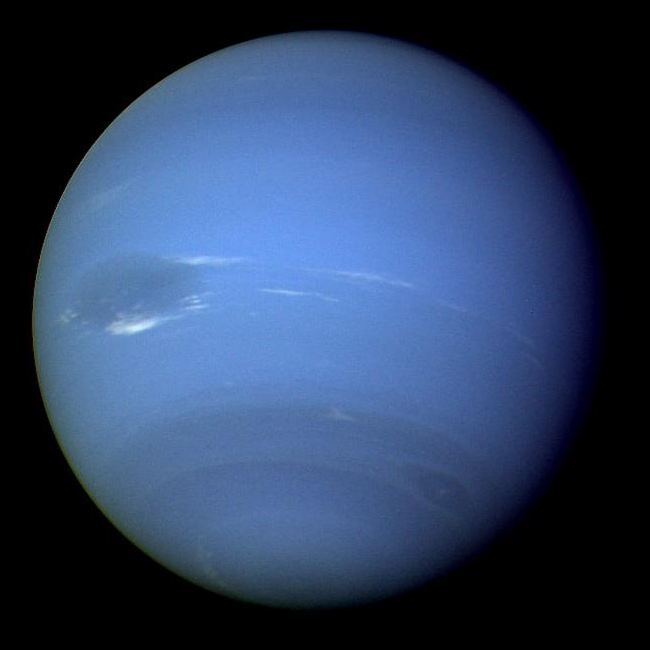
neptune photographed by voyager 2 in 1989 — the planet whose existence was predicted by mathematics in 1846 before it was ever seen through a telescope. source: wikimedia commons

Before Neptune, planets were things you saw. After, things you could infer. Mathematical models were not just descriptive but predictive. Exoplanets are now discovered by detecting wobbles in distant stars -- same principle: infer the unseen from its effects on the seen.
Two people with pencil and paper predicted a planet's location 2.8 billion miles away. They calculated where to look, and the planet was there. The universe is complex but not arbitrary. Neptune proved that the right model can find things you did not know you were looking for.