on-this-day · january 3

the hamilton electric 500, the world's first battery-powered wristwatch, introduced in 1957. source: wikimedia commons

Time Without Springs
On this day in 1957 — The Hamilton Electric 500 was introduced, the first electric wristwatch. A tiny revolution in design and engineering.
2 min read
For centuries, timekeeping was a mechanical art. Gears meshed with gears, springs unwound with precision, and watchmakers worked with tolerances measured in fractions of a millimeter. Hamilton Watch Company, based in Lancaster, Pennsylvania, understood mechanical time as well as anyone. They'd been making watches since 1892.
But on January 3, 1957, Hamilton introduced the Electric 500 -- a watch with no mainspring. It ran on a tiny battery and used an electromagnet to drive the balance wheel. The energy source was electrical. It was a hybrid, a bridge between two eras.
The Ventura model's case was designed by Richard Arbib, a car designer who'd worked on Cadillacs. It looked like nothing else on the market -- asymmetrical, shield-shaped, leaning forward. The design could only exist because the electric movement was smaller than a traditional mechanical one. Form followed function, but the function had changed.
The watch didn't sell well at first. It retailed for $275 -- about $3,000 today. Batteries leaked. Movements were fragile. But it proved the concept. Hamilton had spent over a decade developing it, solving problems of miniaturization that had never been tackled before.
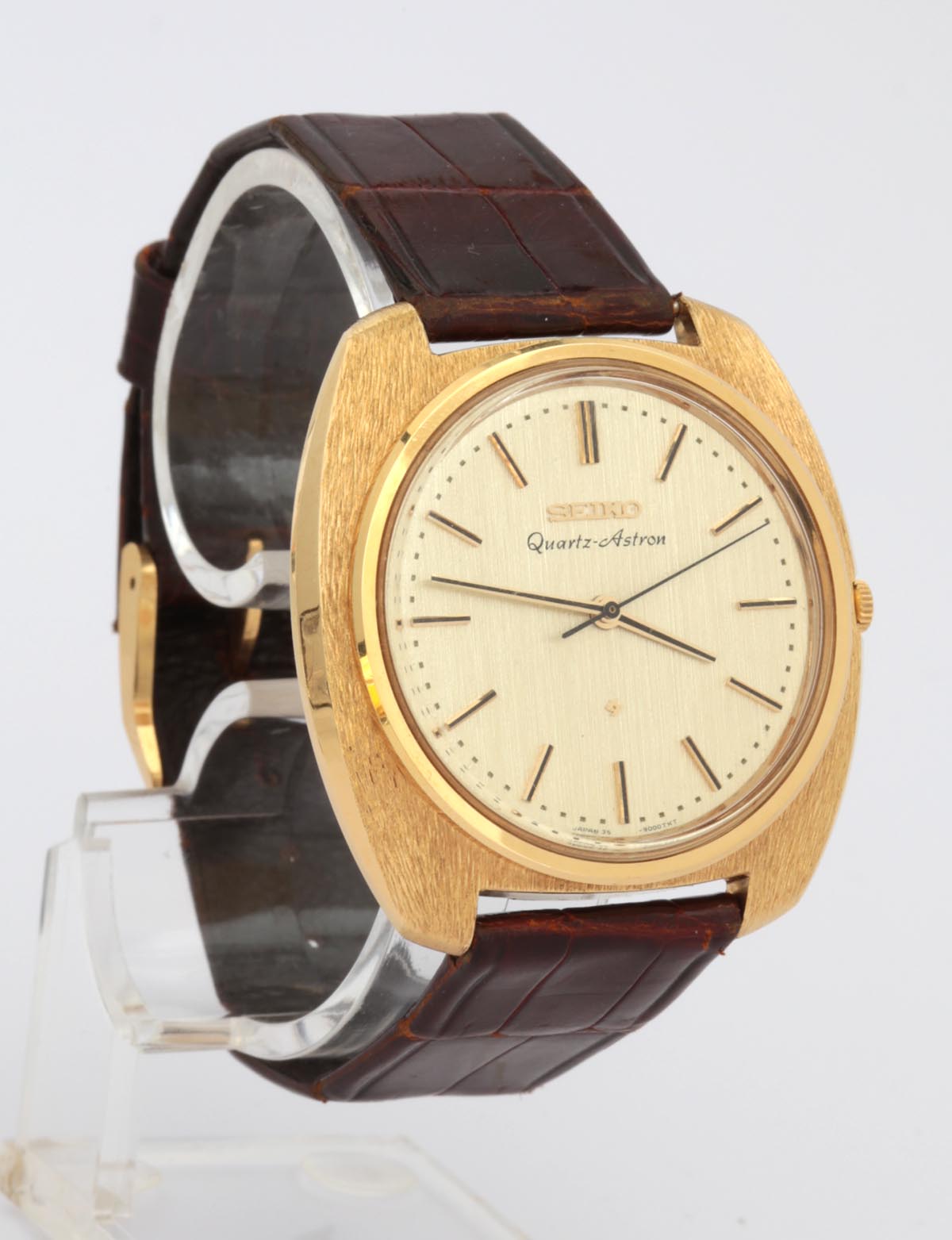
the seiko astron, the world's first quartz wristwatch, introduced in 1969. source: wikimedia commons

Then quartz arrived. In 1969, Seiko's Astron was more accurate, more reliable, eventually far cheaper. The electric watch era lasted barely a decade. The Ventura became a design icon -- famously worn by Elvis -- but as a curiosity, not a technology.
What the Electric 500 did was open a door. It demonstrated that energy could come from chemistry instead of springs, that aesthetics could follow from internal logic rather than tradition. Just as the iPhone later replaced buttons with a touchscreen, the Electric 500 replaced the mainspring with a battery. Every smartwatch and fitness tracker owes something to that asymmetrical watch from 1957.