on-this-day · october 31

martin luther, painted by lucas cranach the elder, 1528. source: wikimedia commons
.jpg)
Ninety-Five Points of Disruption
On this day in 1517 — Martin Luther posted his 95 Theses. A document that redesigned Christianity.
2 min read
On October 31, 1517, Martin Luther, a theology professor and Augustinian monk, posted a document on the door of the Castle Church in Wittenberg, Germany. The "Disputation on the Power and Efficacy of Indulgences" contained 95 theses challenging the Catholic Church's practice of selling indulgences -- essentially, tickets to reduce time in purgatory. Luther did not intend to start a revolution. He wanted a debate. He got the Protestant Reformation.
The indulgence system was the trigger, but the underlying issue was authority. Luther argued that salvation came through faith alone, not through works or payments to the Church. He challenged the Pope's right to forgive sins and questioned the theological basis for purgatory itself. These were not minor objections. They struck at the foundation of the Church's spiritual and economic power.
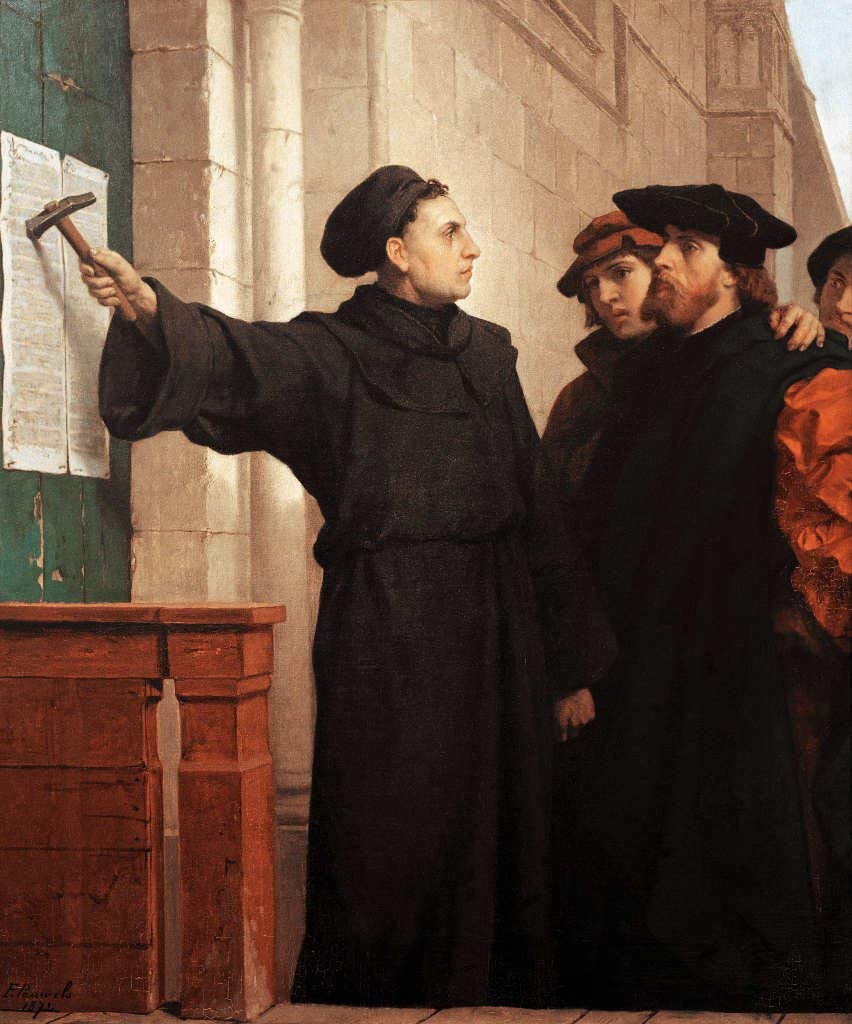
luther hammers his 95 theses to the door of the castle church in wittenberg, painting by ferdinand pauwels, 1872. source: wikimedia commons

The printing press made Luther's protest go viral. Within weeks, copies of the 95 Theses had spread across Germany. Within months, across Europe. Gutenberg's invention, created decades earlier, had been waiting for content explosive enough to demonstrate its power. Luther provided it. The Reformation was the first event to prove that new communication technology could disrupt existing power structures at continental scale.
Luther was not the first to criticize the Church. Jan Hus, John Wycliffe, and others had raised similar objections. They were burned at the stake or silenced. Luther survived because the printing press allowed his ideas to spread faster than authorities could suppress them. October 31, 1517, is the day 95 points of argument nailed to a church door cracked the largest institution in Europe. Luther did not destroy the Catholic Church. He forked it -- creating an alternative branch that competed for users. It was the first great disruption by document, and the printing press was the platform that made it unstoppable.