on-this-day · november 12

saturn's rings photographed by cassini. source: wikimedia commons

The View From 78,000 Miles
On this day in 1980 — voyager 1 made its closest approach to saturn. The photographs changed how we see rings.
2 min read
On November 12, 1980, Voyager 1 made its closest approach to Saturn, passing within 78,000 miles of the planet's cloud tops. The spacecraft had swung past Jupiter in 1979 and used its gravity to slingshot toward Saturn. What it found changed planetary science. The rings, seen through telescopes as a few broad bands, turned out to be thousands of individual ringlets, braided and sculpted by gravitational forces no one had predicted.
Voyager discovered six new moons. Titan was shrouded in a thick nitrogen atmosphere with hydrocarbon haze so dense the surface was invisible. It photographed geysers on Enceladus and mapped the hexagonal storm at Saturn's north pole. The trajectory prioritized the Titan flyby, which sent Voyager 1 out of the ecliptic and ended its planetary mission. If it had failed at Saturn, Voyager 2 would have been diverted to Titan instead of continuing to Uranus and Neptune.
The photographs were stunning. Saturn's rings caught sunlight and scattered it into bands of gold and cream. The planet glowed with muted yellows, gentler than Jupiter's storms. Voyager's cameras turned raw data into images that redefined how humanity pictured the outer solar system. Before Voyager, Saturn was a diagram. After Voyager, it was a place.
Voyager 1 is now over 15 billion miles from Earth. It entered interstellar space in 2012 and still transmits, a faint signal taking nearly a day to reach us. The Saturn flyby was the last time it visited anything. Everything since has been departure. It doesn't explore anymore. It just goes.
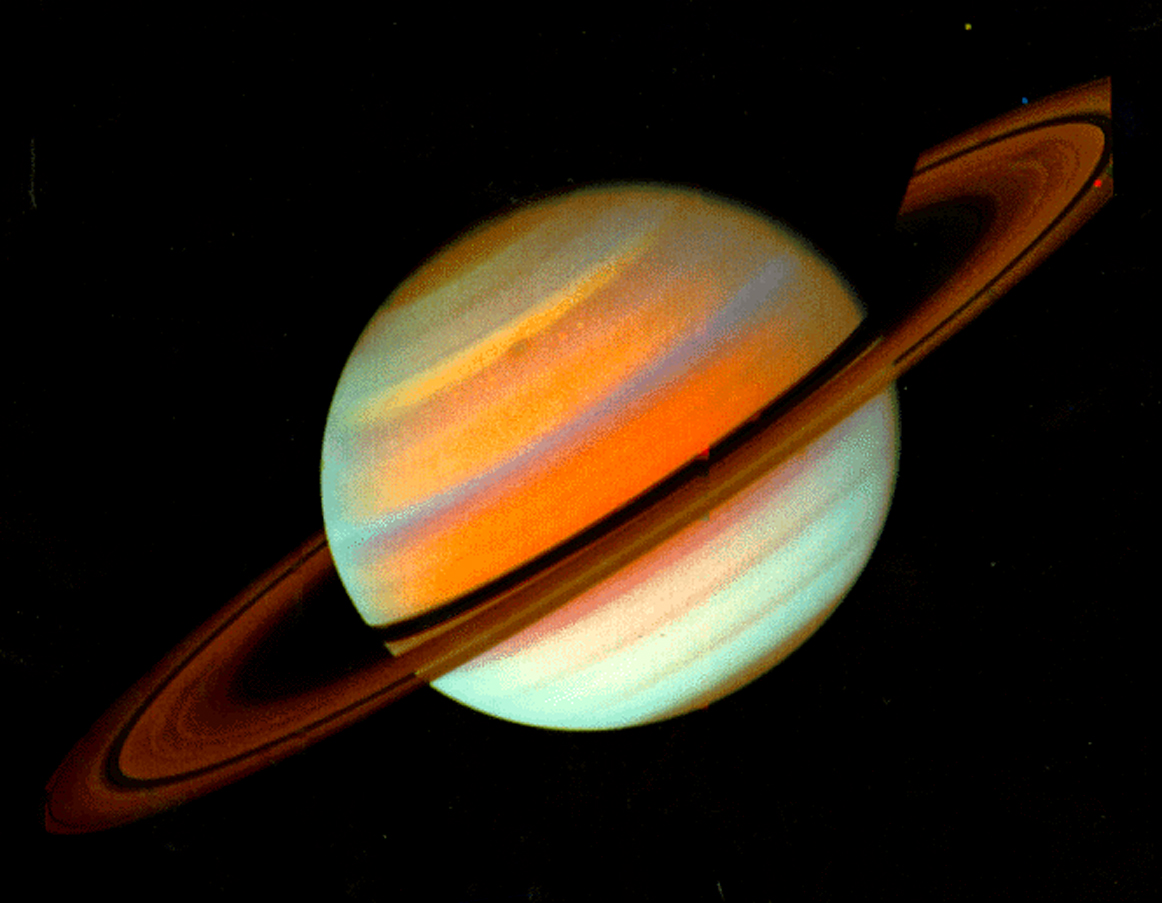
saturn in false color, photographed by voyager 1 during its 1980 flyby. source: wikimedia commons
